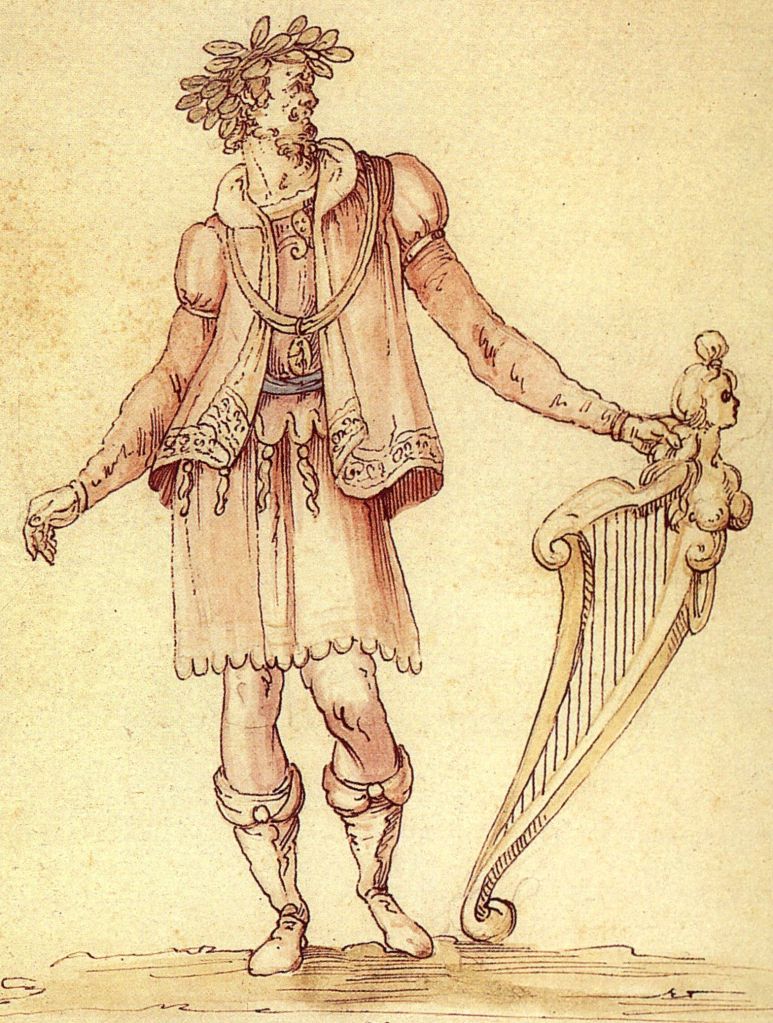
Strangely enough, we have – for once in an art form – a reasonably accurate date for when opera actually started – 1597 (or, as I say, thereabouts). The man responsible is pictured above, Jacopo Peri aka Il Zazzerino (the blond) and the work in question – based on Greek myth – was entitled Dafne. Only a few fragments of that opera have survived, but Peri followed it in 1600 with a second work based on Greek mythology – Euridice; the earliest complete opera text we have.
Jacopo Peri:
Prologue to L’Euridice
Seven years later a slightly younger composer by the name of Claudio Monteverdi also used the tale of the ill-fated Eurydice to make an opera, it was to be the first work in this new musical genre that has remained in repertoire to the present day, he called it Orfeo.
Claudio Monteverdi:
Orfeo, the opening toccata
Orpheus compares his previous unhappiness to the joy of his marriage to Eurydice:
Nearly two hundred years later, in 1762 – we’re fast forwarding a bit – another ground breaking operatic work appeared, based once more on Orpheus and Eurydice, Gluck’s Orfeo ed Euridice.
By this time the genre that had been novel, fresh and lively in Monteverdi’s day had, in Gluck’s view, become tired and clichéd; so he set about making reforms, reforms that were have a major influence on subsequent operatic composers.
Christoph Willibald Gluck:
Orfeo ed Euridice
Act 2, Scene 1 – Dance of the Furies
And then there was Mozart…
Any copyrighted material on these pages is included as “fair use”, for the purpose of study, and critical analysis only, and will be removed at the request of the copyright owner(s).
 The Art of Listening