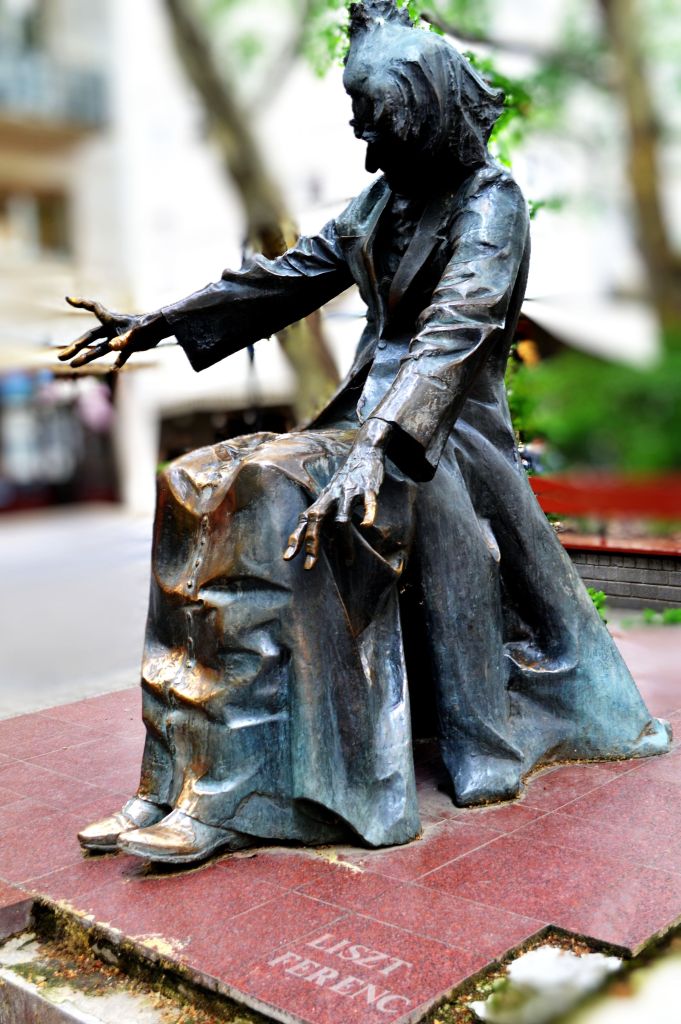
Language and music are frequently central to national identity. During the nineteenth century, industrialisation and its concomitant urbanisation threatened to wipe out whole rural cultures of poetry, song and dance; while paradoxically many ethnic groups felt a growing sense of cultural/national identity based on those very traditions which were in the process of disappearing.
The Hungarians are no exception to this, though, in one particular, their position was almost unique. Magyar, their language, was – unlike all of their neighbouring nations – not part of the Indo-European language family, it’s nearest relatives being from the distant Baltic — the Finns and Estonians.
So, in the spirit of preserving this heritage, one of the most famous of Hungarian musicians, Liszt Ferenc* (aka Franz Liszt) wrote a series – nineteen in all! – of Hungarian Rhapsodies for solo piano some of which were later orchestrated and/or arranged for piano duet.
Unfortunately, since the systematic study of folk music (ethnomusicology) was in its infancy at the time, many of the melodies that Liszt assumed were part of the folk tradition were, in actual fact, written by the aspiring composers of the middle and upper classes. While this partially robs the works of their nationalistic authenticity, their aesthetic credentials remain intact. You can hear the most famous of them in its original virtuoso solo piano version below:
*Hungarian name order (click for information)
It’s usual in Hungary to put the family name before the given; so Franz Liszt becomes Liszt Ferenc and Béla Bartók becomes Bartók Béla.
Any copyrighted material on these pages is included as “fair use”, for the purpose of study, and critical analysis only, and will be removed at the request of the copyright owner(s).
 The Art of Listening