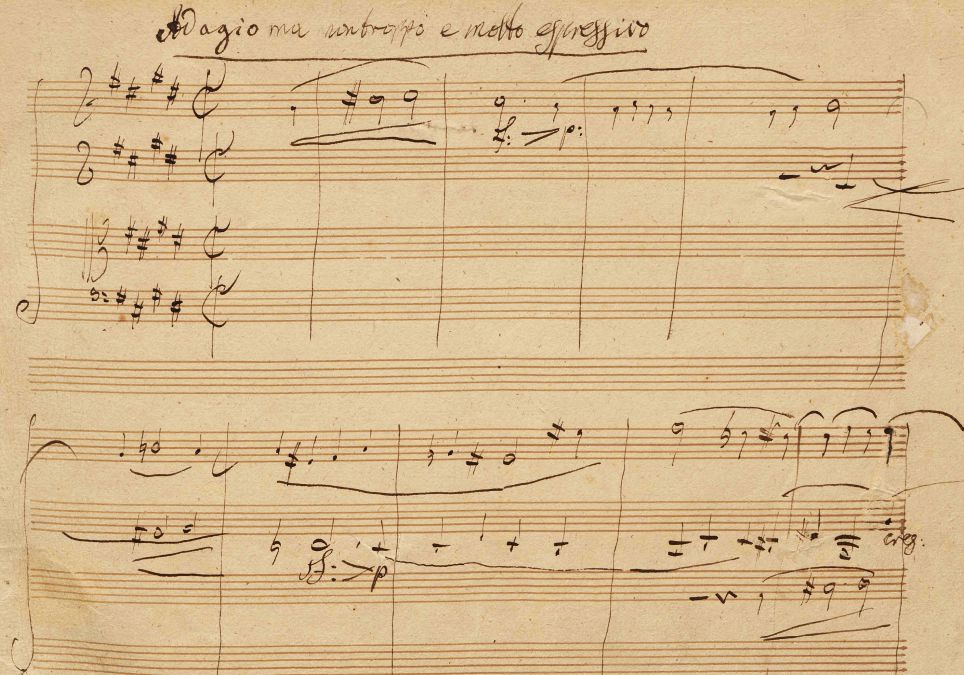
Beethoven’s two final major compositions are both string quartets: Op. 131 in c# and Op. 135 in F. These two quartets are full of contrast both with one another and within themselves.
The c-sharp minor work follows the multi-movement pattern established by the composer’s previous two quartets. It starts with a slow fugue marked molto espressivo, in a world much closer to the rapt contemplation of Op. 132’s Heiliger Dankgesang than the violence of the Grosse Fuge, and then proceeds through a total of six other movements – an Allegro molto vivace, a short recitative-like Allegro moderato, a set of variations marked Andante, an extremely fast Scherzo, a short Adagio and, finally, an an Allegro – all of which, Beethoven instructs, should be played without a break!
The F-major quartet has only four movements, and they follow the traditional pattern of Allegretto/ Scherzo / Slow movement/ Finale (an Allegro with a slow introduction). Unlike its immediate predecessors – all of which last somewhere around ¾ of an hour – this final work last only a Haydnesque twenty minutes.
Above the last movement is written:

… which translates as “The Difficult Decision – Must it be? – It must be!” – cryptic comments that have kept biographers and critics guessing from the nineteenth century to the present day.
Adagio ma non troppo e molto expressivo 0:01
Allegro molto vivace 7:26
Allegro moderato – Adagio 10:24
Andante ma non troppo e molto cantabile 11:13
Presto 25:06
Adagio quasi un poco andante 30:20
Allegro 32:38
Allegretto– 0:12
Vivace– 7:12
Lento Assai– 11:08
Grave, ma non troppo– 19:53
← Back to week 9
← Back to week 8
← Back to week 7
← Back to week 6
← Back to week 5
← Back to week 4
← Back to week 3
← Back to week 2
← Back to week 1
Any copyrighted material on these pages is included as “fair use”, for the purpose of study, and critical analysis only, and will be removed at the request of the copyright owner(s).
 The Art of Listening