The opera A Midsummer Night’s Dream was written in 1959-60. The libretto – written by Britten himself in collaboration with his partner, Peter Pears – reduces Shakespeare’s original five acts to three. The opera is unusual on several counts – the leading male role (Oberon) is sung by a counter-tenor, Puck played by a speaker/acrobat, and the chorus of fairies sung by boy trebles (though the score does allow for sopranos).
As in the play, there are three (or four if you include Puck) distinct groups characters in the work, to each of which the composer allocates a different orchestral sound: celesta, harp and higher woodwind to Oberon, Tytania and the fairies (with high trumpet and side drum for Puck), lower brass for Bottom and his troupe of ‘actors’, and standard orchestral sounds for the two pairs of lovers and the court of Duke Theseus.
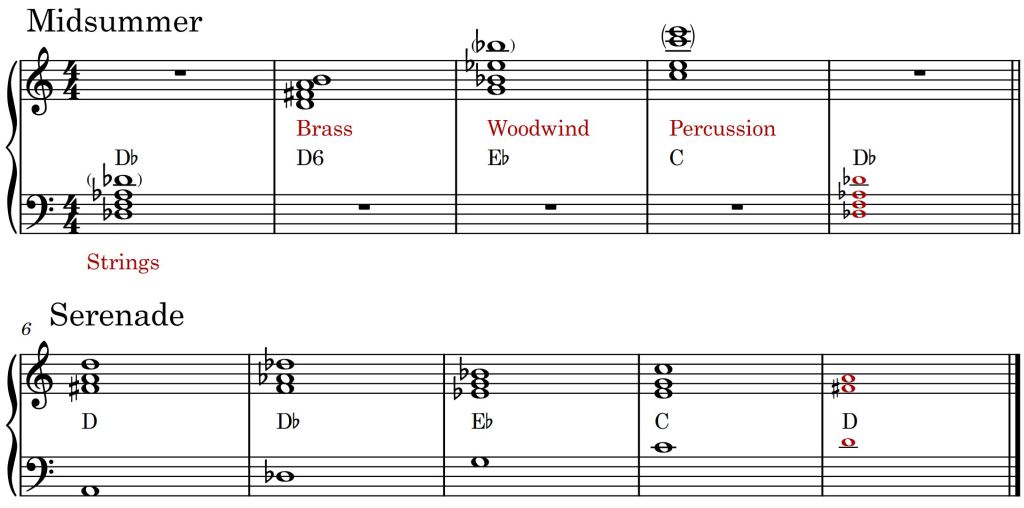
In the opening of Act 2, as night falls, Britten writes variations on a series of four chords which encompass all twelve notes of the chromatic scale, chords which are nearly identical to the sequence that ushers in and dominates the composer’s setting of Keats’ Sonnet to Sleep in his earlier (1943) Serenade for Tenor, Horn and Strings.
The original recording, conducted by Britten:
Act 1: 0:04
Act 2: 46:43
Act 3: 1:35:02
An opportunity to evaluate both the work and it’s interpretation:
Work:
Performance:
Acts 1 & 2 in the Swedish Opera production:
Act 2 47.52
Production:
And, if you feel inclined to expand on your decisions…


… only click ‘Submit’ if you’ve used the ‘Comments’ box. Your (green) yeas and/or (red) nays will be registered automatically.
Any copyrighted material on these pages is included as “fair use”, for the purpose of study, and critical analysis only, and will be removed at the request of the copyright owner(s).
Pantygwydr!
 The Art of Listening