
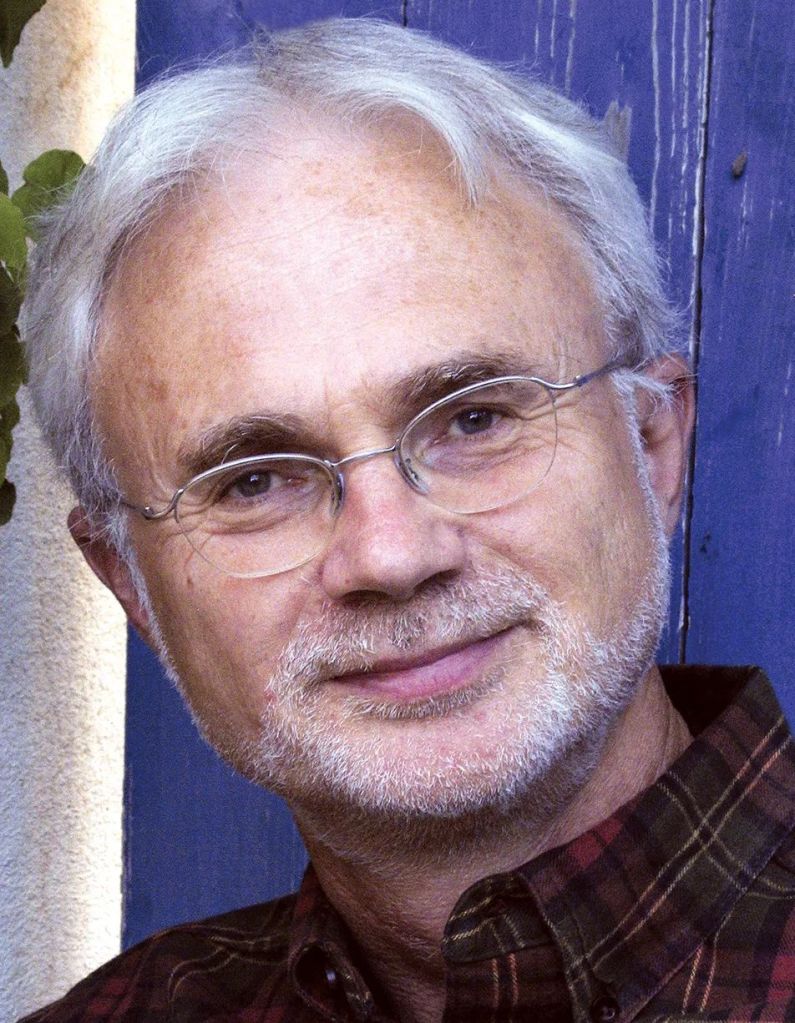
Minimalism really is an American musical phenomenon, and composers such as Terry Riley, Steve Reich and Philip Glass have become well-known as its proponents.
In its most basic form it consists of two principal elements:
Rhythm…
… and (fairly traditional) harmony …
… the combination of the two seemingly replacing the need for surface melodic interest.
But there’s always an exception, and John Adams breaks the minimalist mould in that, while much of his music is in the minimalist style,
… in his eight operas and his later orchestral music one can hear the surfacing of a definite lyrical impulse.
Nixon in China [1987] (title is self explanatory):
Doctor Atomic [2005] (about the about physicist J. Robert Oppenheimer, and the invention of the atomic bomb):
Oppenheimer’s crisis of conscience is dramatised in a setting of John Donne’s sonnet, Batter my heart, three person’d God.
Harmonielehre [1985] is a large orchestral work in defense of tonality. The title, meaning ‘harmony tutor’ was taken from Arnold Schönberg’s – textbook of the same name (Schönberg being, in his later compositions at least, the major figure in the use of atonality).
00:00, Part I, First Movement
18:50, Part II, The Anfortas Wound
30:58, Part III, Meister Eckhardt and ‘Quackie’
Any copyrighted material on these pages is included as “fair use”, for the purpose of study, and critical analysis only, and will be removed at the request of the copyright owner(s).
Pantygwydr!
 The Art of Listening