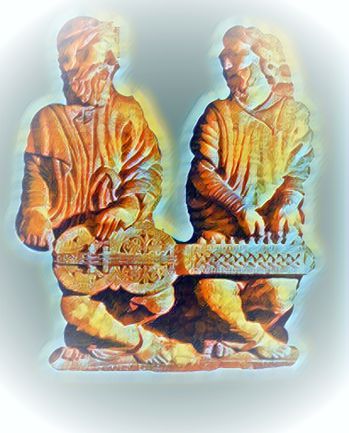
Staying with our hurdy-gurdy men from Santiago for a moment, in terms of instrumental classification the instrument they’re playing is a chordophone which, unlike last week’s various pipe organs which used columns of air to produce musical sound (and are consequently known as aerophones), is an instrument that makes music by vibrating strings.
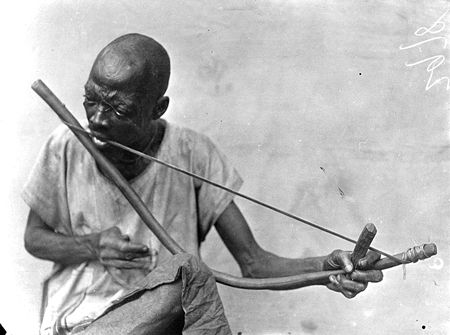
Like aerophones, chordophones have a long history. The monochord, a single stringed instrument, was used by the Pythagoreans to posit the idea of the mathematical harmony of the universe and, on a more mundane level, a simple hunting bow could be easily transformed into a musical instrument:
To return to the Santiago hurdy-gurdy, you can see that a connection between chordophones and keyboards already had an established history by 1211; and, as the keyboards got more sophisticated, so – in fairly short order – (14th century?) there arrived instruments of the clavichord and harpsichord type.
There are differences between the clavichord and harpsichord families, the main one being that the clavichord produces its sounds by striking its strings with a small metal weight (and so is relative of the piano), while the harpsichord and its relatives (the virginals and the spinet) has its strings plucked by a – nowadays mostly plastic – plectrum. Here’s a clavichord rendering of Mozart’s Rondo alla Turca:
…and here, for comparison, is the same piece played on the harpsichord:
As you can hear, the clavichord’s not a loud instrument and was mostly used by players/composers for personal music making rather than the entertaining of audiences, where its retiring nature would be a distinct disadvantage.
The harpsichord is a different story being a louder and more public instrument, though it too had smaller, more domesticated versions in the virginals and the spinet. Here’s the spinet, distinguished by its strings being at about 30 degrees to the keyboard:
And here – strings parallel to the keyboard – is the easily transportable version of the harpsichord, the virginals:
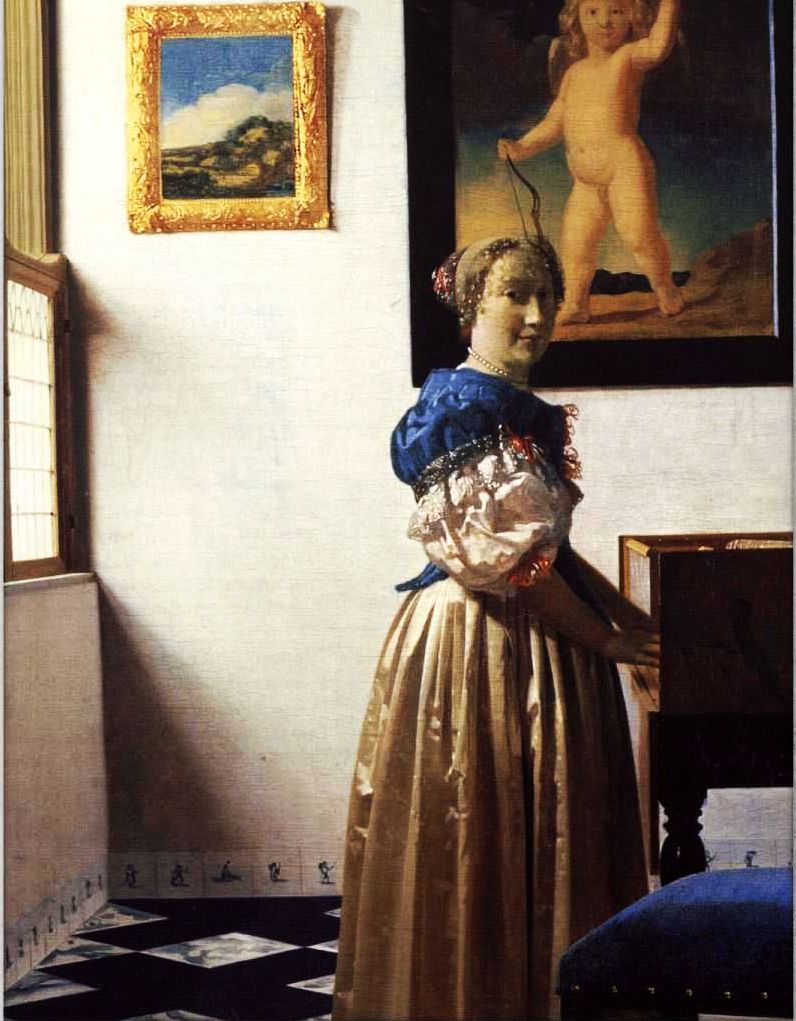
As for the harpsichord itself, it has had much extremely distinguished music written for it – a few examples:
Theme and variation one of Bach’s Goldberg Variations:
Handel, Suite in d minor:
1- Ouverture 00:07
2- Allemande 04:20
3- Courante 07:17
4- Sarabande 08:53
5- Menuet 11:28
6- Gigue 12:27
Any copyrighted material on these pages is included as “fair use”, for the purpose of study, and critical analysis only, and will be removed at the request of the copyright owner(s).
 The Art of Listening