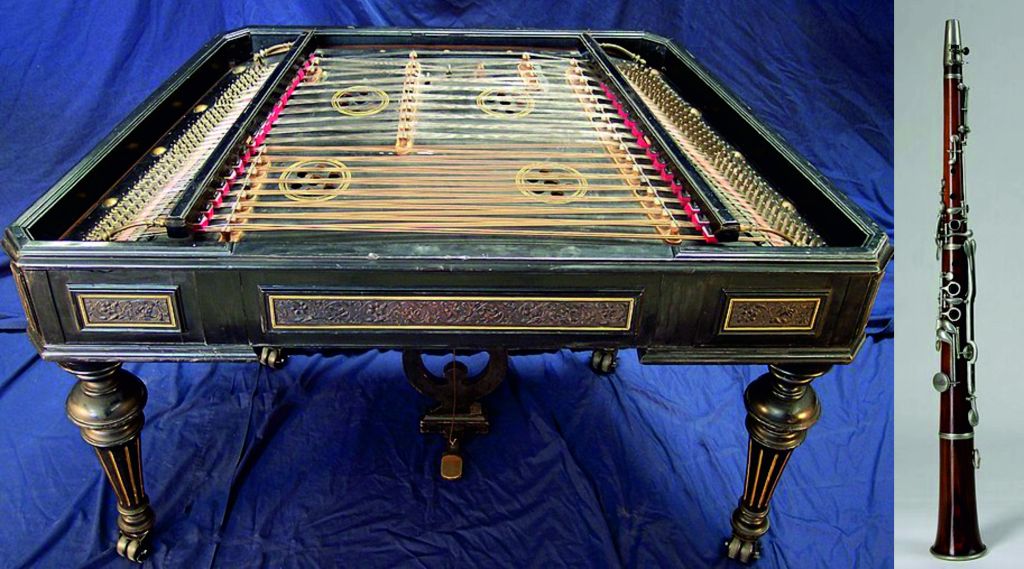
Two uniquely(?) Hungarian instruments: the cimbalom and tárogató.
The cimbalom – a sort of dulcimer – was, originally, a folk instrument but received a rather dramatic make-over in 1874 when the Schunda family of instrument makers proudly unveiled their concert cimbalom
The Schundas were also responsible for upgrading the tárogató – a single reed wind instrument, akin to a clarinet – from its folk roots to the keyed instrument you see above.
The two instruments are important because their techniques and timbres are often imitated by indigenous (and other!) composers to conjure a ‘Magyar’ sound in their works. Also, while the clarinet is mostly used as a substitute for the tárogató, there are several well-known scores in which the cimbalom itself puts in an appearance.
You can hear both cimbalom and tárogató played in the videos below.
Here’s Liszt imitating the cimbalom with it repeated notes at the opening of his Eighth Hungarian Rhapsody…
… and here, in the same key of f#-minor, but not quite so overtly nationalistic, is another Rhapsody by a Hungarian composer – Ernő Dohnányi, plays his own composition:
Any copyrighted material on these pages is included as “fair use”, for the purpose of study, and critical analysis only, and will be removed at the request of the copyright owner(s).
 The Art of Listening