
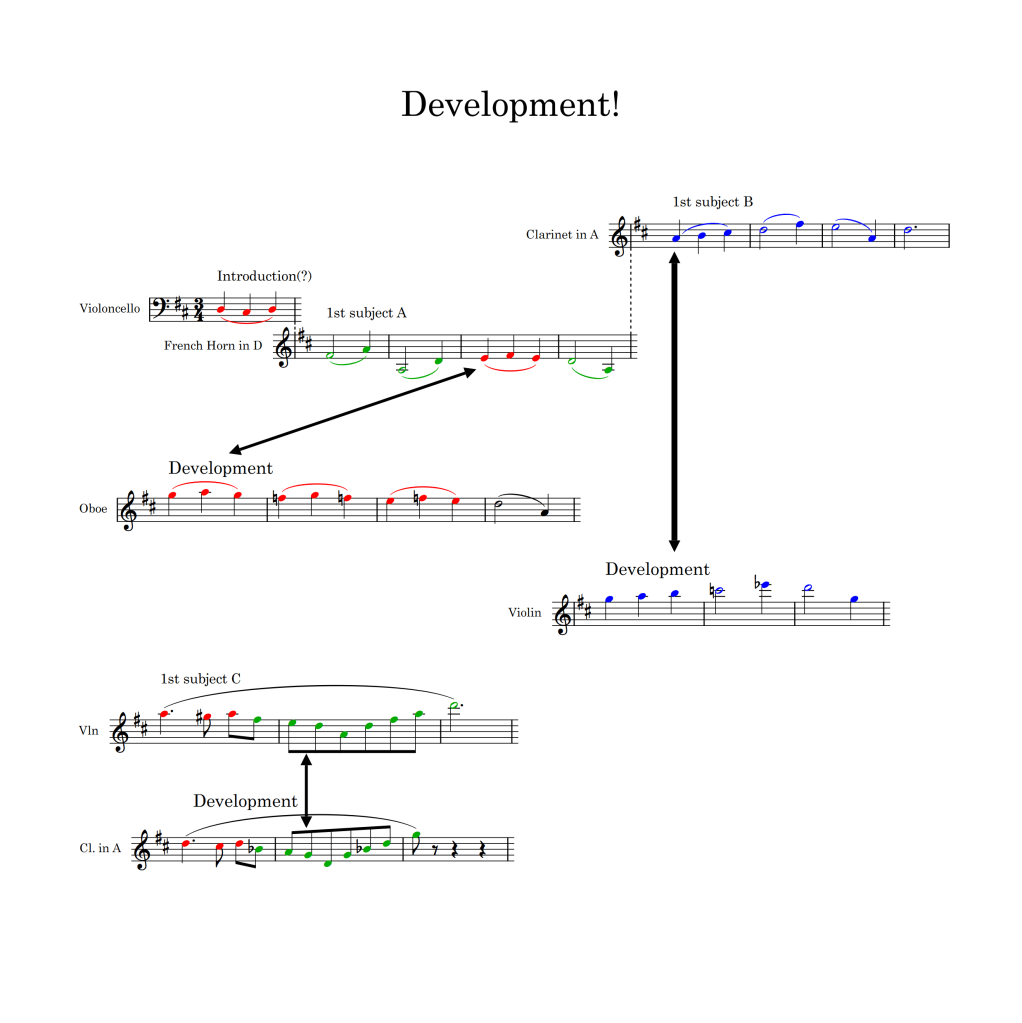
Last week we examined the opening [exposition] section of the first movement of Brahms’ Second Symphony as a way into the composer’s musical thinking. This week it’s the turn of the middle [development] section (You can go straight to Carlos Kleiber’s interpretation of said development by clicking here.)
Listen:
Brahms: Symphony No. 2 in D, Op. 73
00:45 – I. Allegro non troppo
15:25 – II. Adagio non troppo
25:05 – III. Allegretto grazioso (Quasi Andantino)
30:35 – IV. Allegro con spirito
Work:
Performance:


… only click ‘Submit’ if you’ve used the ‘Comments’ box. Your (green) yeas and/or (red) nays will be registered automatically.
Apart from the four symphonies, Brahms also wrote a considerable amount of chamber music. There are string quartets, quintets and sextets; sonatas for violin, for cello and for clarinet; piano trios and a quintet for piano and strings.
Amongst the earliest of these works is the String Sextet Op. 18, written in 1860 when the composer was just twenty-seven. It’s scored for two each of violins, violas and cellos.
String Sextet No. 1 in B-flat, Op. 18
00:00 Allegro ma non troppo
11:38 Andante ma moderato
20:38 Scherzo: Allegro molto
23:44 Rondo: Poco allegretto e grazioso
Work:
Performance:
… only click ‘Submit’ if you’ve used the ‘Comments’ box. Your (green) yeas and/or (red) nays will be registered automatically.
Finally, a choral work. Brahms’ fine setting of Friedrich Hölderlin’s Schicksalslied [Song of Destiny]:
(with English translation)
Work:
Performance:
Any copyrighted material on these pages is included as “fair use”, for the purpose of study, and critical analysis only, and will be removed at the request of the copyright owner(s).
Pontarddulais!
 The Art of Listening