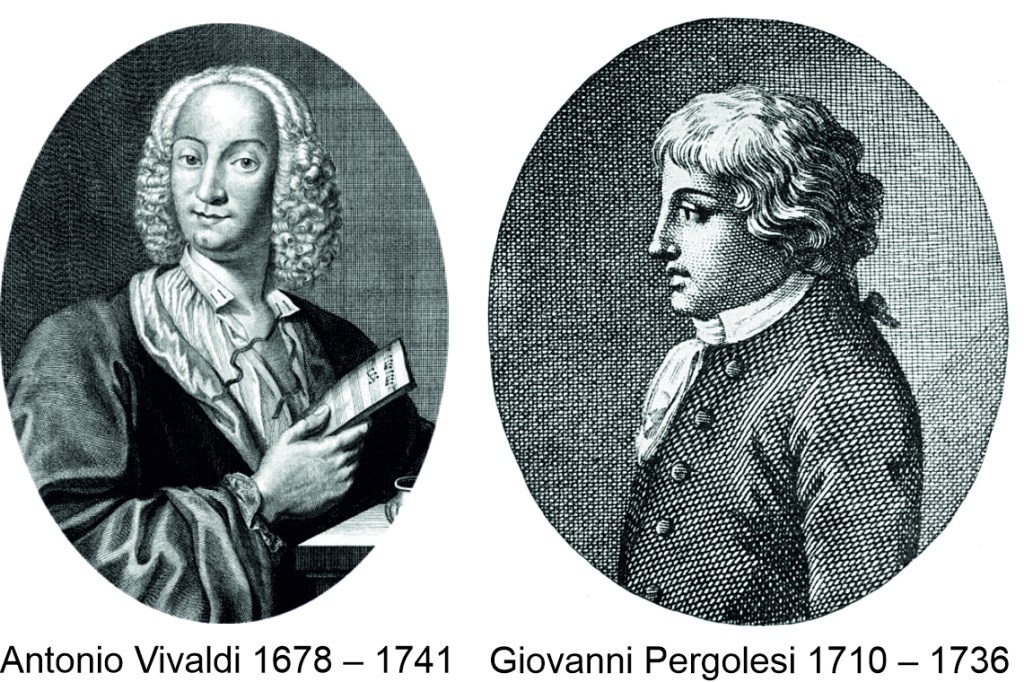
Two of the most famous figures of the Italian Baroque. Pergolesi – as you can see – died tragically young (at 26, of tuberculosis), while Vivaldi had, for the time, a long life but, sadly, ended it in Vienna in a state of poverty.
Pergolesi’s Stabat Mater is – together with the opera buffa, La serva padrona – one of the composer’s most famous works; it’s written for soprano and alto voices, strings and continuo. The opening is justly famous: in order to illustrate musically the anguish of Mary, Jesus’ mother, at the crucifixion of her son, Pergolesi makes brilliant use of a technique known as durezze e ligature – a string of dissonances each of which only very, very briefly resolve into consonance.
00:54 Stabat Mater Dolorosa
05:18 Cujus animam gementem
07:20 O quam tristis et afflicta
09:27 Quae moerebat et dolebat
11:28 Quis est homo
14:20 Vidit suum dulcem natum
17:52 Eja mater fons amoris
20:06 Fac ut ardeat cor meum
22:13 Sancta mater, istud agas
27:26 Fac ut portem Christi mortem
31:12 Inflammatus et accensus
33:09 Quando corpus morietur (Largo assai)
36:40 Quando corpus morietur (Presto assai)
Text (English translation – Page 2)
Vivaldi, prolific composer that he was, has three Gloria settings to his name. The first isn’t well known, the second is what’s popularly known as the Vivaldi Gloria (you can hear a version of it below) and the third is lost.
00:00:18 Gloria in excelsis Deo
00:02:48 Et in terra pax
00:07:46 Laudamus te
00:10:04 Gratias agimus tibi
00:10:27 Propter magnam gloriam
00:11:17 Domine Deus
00:14:32 Domine, Fili unigenite
00:16:41 Domine Deus, Agnus Dei
00:20:34 Qui tollis peccata mundi
00:21:40 Qui sedes ad dexteram Patris
00:24:14 Quoniam tu solus sanctus
00:25:00 Cum Sancto Spiritu
Any copyrighted material on these pages is included as “fair use”, for the purpose of study, and critical analysis only, and will be removed at the request of the copyright owner(s).
 The Art of Listening