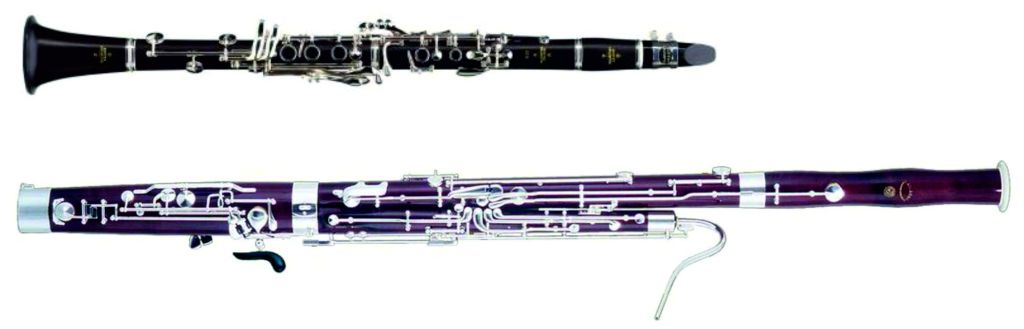
The clarinet is a relatively late arrival in the woodwind family. Unlike the flute, oboe and bassoon, you won’t find any baroque music for clarinet – its serious usage really started in the late 18th century. And it’s Mozart’s championing of the instrument with his late concerto and quintet that undoubtedly helped to secure its permanent place in the orchestra.
The instrument has a large family. Apart from the standard B-flat and A clarinets there are bass, contrabass, basset horns, alto, and several sub-species of piccolo clarinets. Its range (here for the B-flat clarinet) is extensive, with the upper limit again depending very much on the individual player….
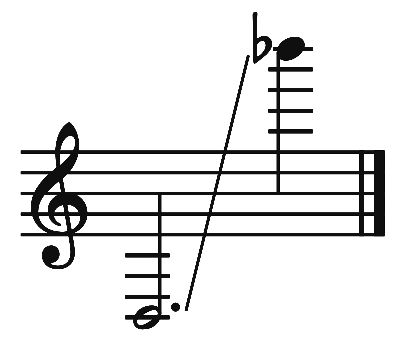
… and its agility and articulation almost the equal of the flute.
Mozart: Clarinet concerto in A, K. 622
Don’t recognise the instrument? Well, it is a clarinet, but a clarinet as modified by Mozart’s friend, the clarinet virtuoso, Anton Stadler, who extended the range of the instrument down from the E below middle C by two tones to a low C – hence the unfamiliar construction; the instrument’s called a basset clarinet.
00:00 Allegro
12:58 Andante
20:14 Rondo. Allegro
There have been a whole string of virtuoso clarinetist who have inspired – or, more prosaically, commissioned – composers to write works for them. Anton Stadler (Mozart), Heinrich Baermann (Weber, Mendelssohn, Meyerbeer), Richard Mühlfeld (Brahms) and, in the twentieth century the jazz clarinetist Benny Goodman (Copland, Bartók, Poulenc, Hindemith). Here’s the concerto Copland wrote for him:
Copland: Clarinet concerto
00:00 Slowly and expressively
08:48 Rather Fast
The bassoon was fortunate to evolve – mostly from an instrument called the dulcian – rather earlier than the clarinet and so has a significant baroque repertoire (there are (amazingly) over thirty concertos for the instrument by Vivaldi alone). It formed a frequent part of the bass continuo in Bach’s time, graduating from there to a permanent position as the bass of the woodwind ensemble in the ‘classical’, Romantic and modern orchestras.
Its range is about three octaves plus a fifth…
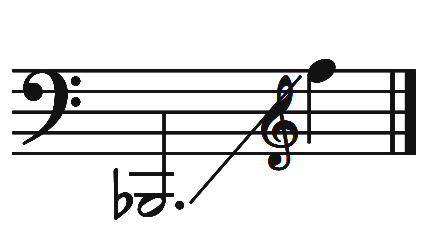
… and while not quite as agile as the flute or clarinet, as the concertos below demonstrate, it’s no sluggard!
Vivaldi: Bassoon concerto in B-flat
La Notte [The Night]
00:00 – I. Largo (to Andante molto)
02:23 – II. I Fantasmi: [Ghosts] Presto
03:49 – III. Presto (to Adagio)
04:17 – IV. Il Sonno: [Sleep] Andante molto
06:39 – V. Sorge L’Aurora: [Dawn] Allegro
A concerto by the twentieth century French composer, André Jolivet:
00:00:00 Recitativo
00:07:41 Largo cantabile
Any copyrighted material on these pages is included as “fair use”, for the purpose of study, and critical analysis only, and will be removed at the request of the copyright owner(s).
Pontarddulais!
 The Art of Listening