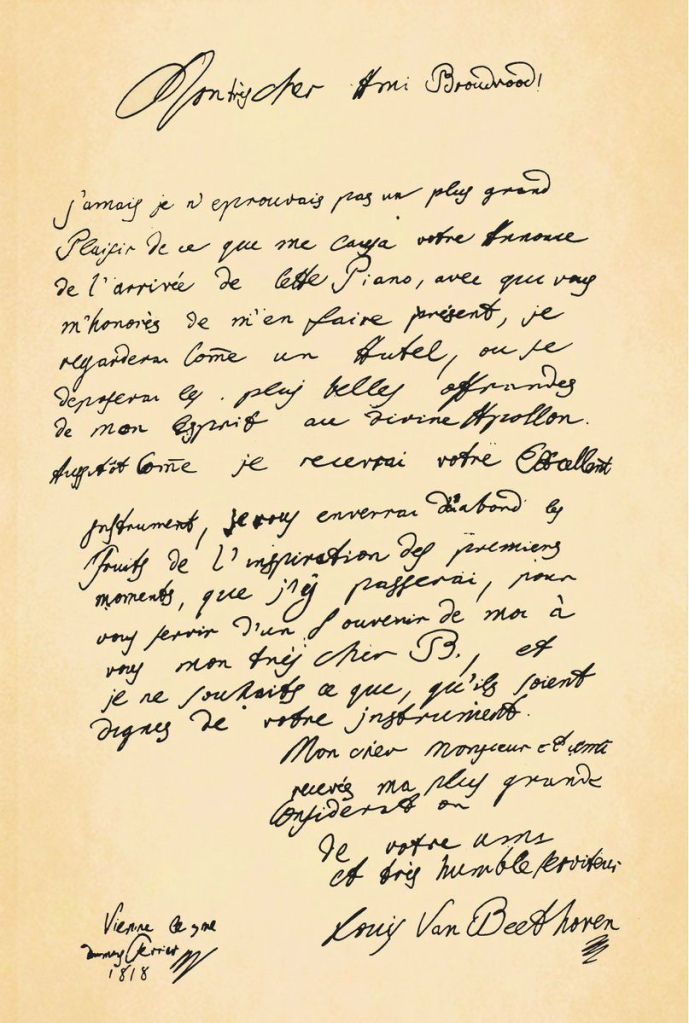
My dearest friend Broadwood,
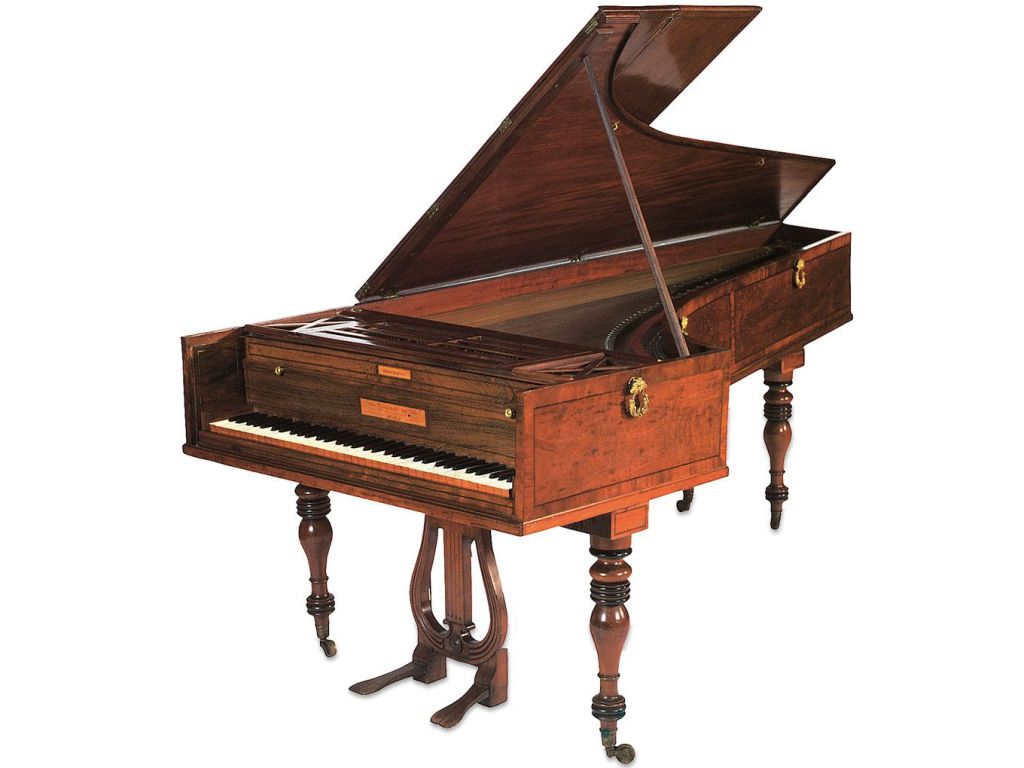
I have never felt a greater pleasure than that given me by the anticipation of the arrival of this piano, with which you are honouring me as a present. I shall regard it as an altar on which I shall place my spirit’s most beautiful offerings to the divine Apollo. As soon as I receive your excellent instrument, I shall send you the fruits of the first moments of inspiration I spend at it, as a souvenir for you from me, my very dear B., and I hope that they will be worthy of your instrument.
My dear sir and friend, accept my warmest consideration, from your friend and most humble servant,
Louis Van Beethoven
Vienna, 3rd February 1818.
Beethoven’s letter (in French!) thanking Thomas Broadwood for the 1818 gift of a piano.
Beethoven’s 32 piano sonatas are, incontestably, among the greatest works written for the keyboard. Here are three of them, from the beginning, the middle and the end of his career.
Sonata No. 1 in f, Op. 2 showing, unsurprisingly, a debt to Mozart and its dedicatee, Haydn:
00:00 Allegro
06:14 Adagio
11:09 Allegretto
14:33 Prestissimo
Sonata No. 21 in C, Op. 53 – Waldstein (1804). Extending the limits of what’s possible:
0:38 – Allegro con brio
12:19 – Adagio Molto
15:54 – Allegretto moderato
Sonata No. 29 in B-flat, Op. 106 – Hammerklavier (1818). An Everest of piano writing, with technical and musical demands that some would argue push both instrument and executant beyond the limits of mechanical and human possibility:
00:00 – Allegro
10:15 – Schezo: Assai vivace
12:44 – Adagio sostenuto
29:52 – Introduzione: Largo -Allegro – Fuga: Allegro risoluto
Any copyrighted material on these pages is included as “fair use”, for the purpose of study, and critical analysis only, and will be removed at the request of the copyright owner(s).
 The Art of Listening