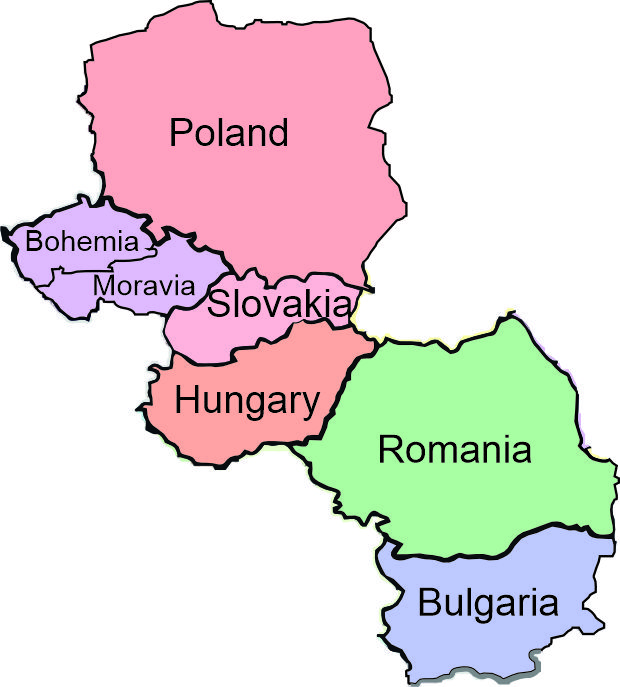
The works that brought Antonín Dvořák (1841-1904) to the attention of the international musical public were his Slavonic Dances.
Brahms, who had taken the younger composer under his wing, had published the first two books of his own extremely successful Hungarian Dances in 1869; so Simrock – Brahms and Dvořák’s publisher – had, with an eye no doubt to a rather lucrative outcome, suggested that the Czech composer follow suit and produce a similar series of Slavonic dances.
Unlike Brahms, who had used what he thought were Hungarian folk tunes (it turned out some of them weren’t!) for his works, Dvořák took the basic rhythms etc., of his chosen dances but wrote his own melodies.
The result was so well received that 8/9 years later the composer – to Simrock’s delight – produced a second set.

Dvořák: Slavonic Dances, op. 46 (1878)
1: Furiant (Presto) 0:07
2: Dumka (Allegretto scherzando) 4:14
7: Scočná (Allegro assai) 10:07
8: Furiant (Presto) 13:56
Dvořák: Slavonic Dances, op. 72 (1886-87)
0:00 No. 1 (9) in B major (Odzemek)
4:28 No. 2 (10) in E minor (Starodávný)
10:35 No. 3 (11) in F major (Skocná)
14:15 No. 4 (12) in D♭ major (Dumka)
20:20 No. 5 (13) in B♭ minor (Špacírka)
23:20 No. 6 (14) in B♭ major (Starodávný/”Ancient”)
27:20 No. 7 (15) in C major (Kolo)
30:45 No. 8 (16) in A♭ major (Sousedská)
Any copyrighted material on these pages is included as “fair use”, for the purpose of study, and critical analysis only, and will be removed at the request of the copyright owner(s).
Pontarddulais!
 The Art of Listening