
The second movement of the Second Symphony is in B-major and is marked Adagio non troppo (very slow (but not too very slow!)) and starts with this splendidly long melody for the cellos:
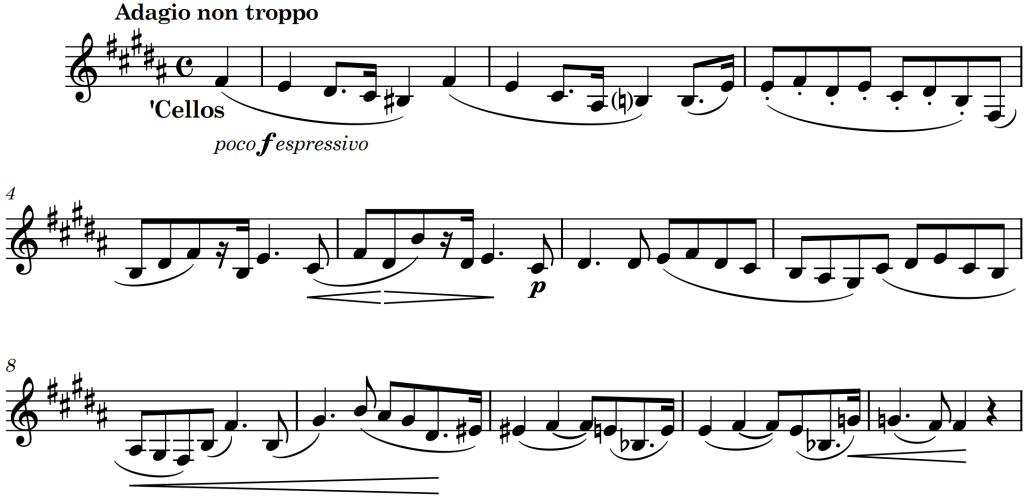
There follows a bridge section in which the horn takes the lead with a gently rocking figure…

… leading to a new woodwind theme, a new time signature and a new key, F-sharp major (the dominant of B):

Finally, there’s a second theme, also in F-sharp, this time scored for the full string section:

All of which would lead you to suppose that this movement is going to be, like the first, a sonata. But…
Brahms: Symphony No. 2 in D, Op. 73
00:00 Allegro non troppo
14:50 Adagio non troppo
24:34 Allegretto grazioso (quasi andantino)
29:56 Allegro con spirito
Work:
Performance:


… only click ‘Submit’ if you’ve used the ‘Comments’ box. Your (green) yeas and/or (red) nays will be registered automatically.
Nine songs Op. 69
These nine songs aren’t genuine folksongs, they’re just Brahms imitating the vernacular. The note that accompanies the YouTube video is pretty comprehensive; I can do no better than to reproduce it here:
The first two songs of Op. 69, both entitled “Klage” (“Lament”), are settings of Bohemian (I) and Slovakian (II) poems, as translated by Joseph Wenzig. In each poem, a woman bemoans her separation from her lover. The first asks, in an earthy metaphor, “Tell me, how can one till soil without a plow, without horse?” — while the second relates how her parents have forced her to become engaged to a man she does not love. Both settings are strophic and in both the influence of the folk song is apparent in the diatonic melody and in Brahms’ repetition of the final line of each strophe. Another Bohemian poem translated by Wenzig, “Abschied” (“Farewell”), is the parting speech of a man who must leave a woman. The strophic setting, in E flat major, features a continuously flowing melody that contrasts with the dotted figures of the introduction. “Des Liebsten Schwur” (“The Sweetheart’s Promise”), also a Bohemian text, describes a young woman’s secret liaisons with a lover in her father’s garden, where the man promised to marry her. After the longest introduction of the set, a leaping melody expresses the heightened expectations of the young woman in this strophic setting. In Karl Candidus’ “Tambourliedchen” (“Drummer’s Song”), a drummer’s instrument changes tone when he thinks of his sweetheart. Each verse in Brahms’ martial, strophic setting closes with a refrain on the blue-gray color of his sweetheart’s eyes. Josef von Eichendorff’s “Vom Strande” (“From the Shore”), a translation of a traditional Spanish poem, describes a woman calling from the shore to a ship carrying away her loved one. He does not hear her, and her lamentations only fill the sails of the “fleeting castles” that have stolen her sweetheart. In 6/8 time and A minor, rising, falling, and turning figures evoke images of passing waves as the piano accompaniment vacillates between 6/8 and 3/4. “Über die See” (“Across the Sea”), by Karl Lemcke, is also a lament of a woman whose man has sailed away. Again opening without a piano introduction, Brahms’ simple strophic setting, in E minor, is not as illustrative as is “Vom Strande.” Gottfried Keller’s “Salome” describes an arch plot by a woman to subjugate and defeat a man. Brahms’ varied strophic setting, the only example of the form in the Op. 69 songs, reflects the metric disparity between the two verses of the text. Siegfried Kapper’s “Mädchenfluch” (“Maiden’s Curse”), based on a Serbian poem, expresses the wish of a young woman to condemn a man, Javo, to a life with her. The central verses are set strophically in 2/4, while the last returns to portions of the opening triple-meter, verses.
Work:
Performance:
… only click ‘Submit’ if you’ve used the ‘Comments’ box. Your (green) yeas and/or (red) nays will be registered automatically.
Any copyrighted material on these pages is included as “fair use”, for the purpose of study, and critical analysis only, and will be removed at the request of the copyright owner(s).
Pontarddulais!
 The Art of Listening