
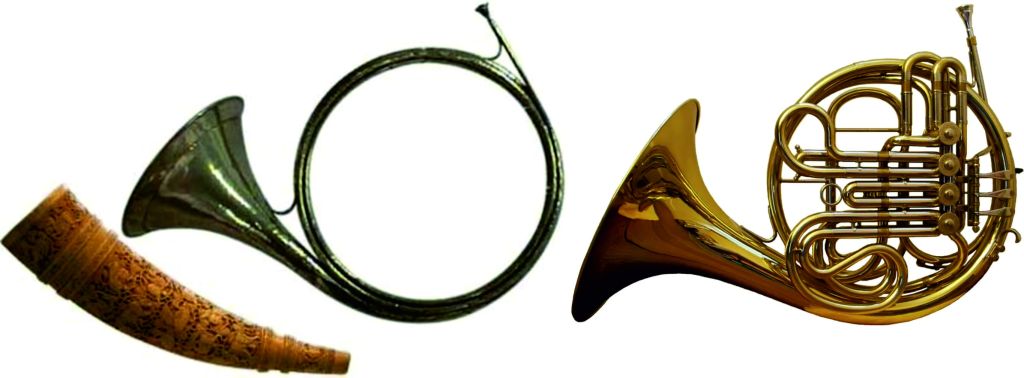
As you can see, the horn started out life as, literally, an animal horn, then developed into the ‘natural’ (no valves or pistons) instrument, eventually ending up as the rather complicated piece of machinery you see on the right.
All three versions of the instrument – as are all the orchestral brass – are based on the same acoustic phenomenon – the overtone series. Every sounded pitch is coloured by a series of ‘ghost’ notes that give its timbral quality, its individual instrumental sound. These ghost notes are known as harmonics, overtones or partials. By changing lip shape and breath quality a horn player can move through these partials up as far as – and sometimes beyond – the sixteenth. Here, as an example, are the basic available pitches on the natural horn in F:
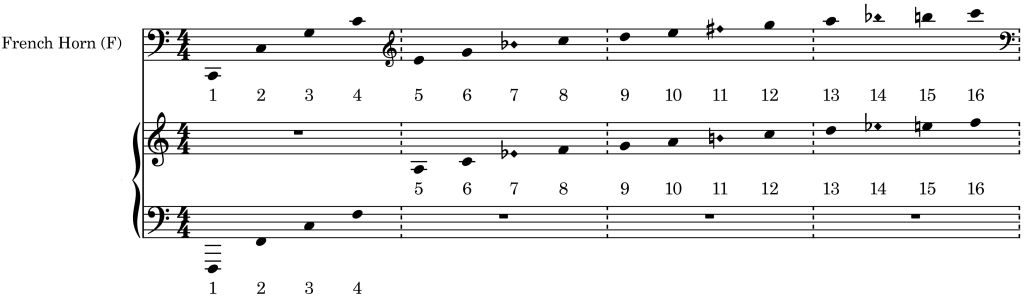
(the diamond shaped notes above are approximate i.e. they’re flat, ‘out of tune’.)
By moving a hand inside the flared end of the instrument (the bell) and so shortening the tube slightly and changing the embouchure (the lip shape) it’s possible to adjust and modify all sixteen pitches.
Two examples of the use of the natural horn by Bach:
Bach: Quoniam (Mass in b) &
Brandenburg concerto No. 1
For Bach and his contemporaries the horn and trumpet were limited to the top end of the overtone series where the notes were close together. By Mozart’s time the use of hand modifications to pitch had allowed the full use of the middle range of the horn, as you can see and hear below:
Mozart: Horn concerto No. 1 in D, KV 412: Rondo (Natural Horn)
Then came the invention of valves and pistons; now the length of the instrument, which had previously been fixed, could be changed at the touch of a button or lever, and a whole new sound world opened up…
Robert Schumann:
Konzertstück for 4 Horns and Orchestra
Richard Strauss: Horn concerto No. 2
01:10 – Allegro
10:21 – Andante con moto
16:02 – Rondo: Allegro molto
Any copyrighted material on these pages is included as “fair use”, for the purpose of study, and critical analysis only, and will be removed at the request of the copyright owner(s).
Pontarddulais!
 The Art of Listening