
Britten’s writing for choir ranges from A Boy was Born written in 1933 when the composer was 19 (a work which, together with the Frank Bridge Variations, did much to establish the young composer as a major new voice in British music) through to Sacred and Profane for unaccompanied chorus written in 1975, the year before his death.
These pieces range from the a capella setting of A Boy was Born through to music that uses large forces – soloists, choruses, orchestra – such as the War Requiem and Spring Symphony.
A Boy was Born is a theme and six choral variations, each of which sets a different carol text, the majority of which are mediaeval (the exception being the use of Christina Rosetti’s In the bleak mid Winter in Variation Five). Here’s the basis of the theme:
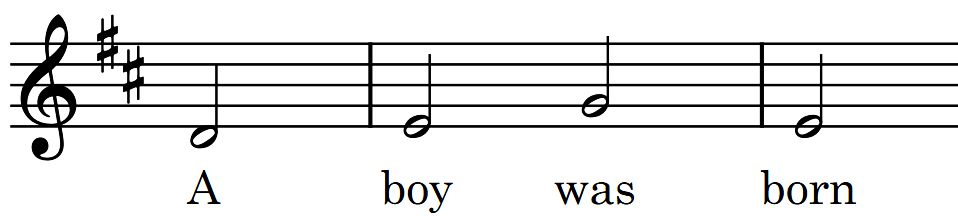
You can hear the other five carol settings/variations by clicking here.
A Ceremony of Carols is one of the composer’s most popular works and, like A Boy was Born, is also based around mostly Middle English texts dealing with the Nativity; it was written in 1942 as Britten returned from America. Originally scored for treble voices and harp, it was also arranged (by the composer) in 1943 for mixed choir (SATB).
00:18 1. Procession “Hodie Christus natus est”
01:57 2. Wolcum Yole!
03:22 3. There is no rose
05:52 4. That yongë child
07:38 5. Balulalow
09:01 6. As Dew in Aprille
10:04 7. This Little Babe
11:38 8. Interlude
15:59 9. In Freezing Winter Night
19:32 10. Spring Carol
20:45 11. Deo gracias – Adam lay i-bounden
21:55 12. Recession “Hodie Christus natus est”
The Spring Symphony (1949) is a choral work which uses large forces – three vocal soloists, mixed choir, boys choir and orchestra. It’s in four sections which correspond to the standard symphonic movements (an Allegro: a slow movement: a Scherzo and a Finale) with each section consisting of settings of between two and five poems. It was commissioned by the Koussevitzky Music Foundations.
You can listen to the entire work on YouTube, click here.
Any copyrighted material on these pages is included as “fair use”, for the purpose of study, and critical analysis only, and will be removed at the request of the copyright owner(s).
Pantygwydr!
 The Art of Listening