
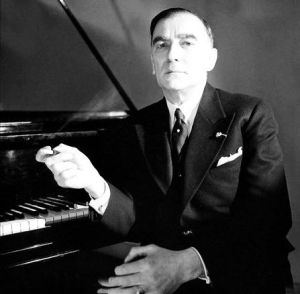
A good way to understand Szymanowski’s career as a composer is through his four symphonies:
The first belongs in the late Romantic sound world of early Schönberg or the Strauss of Salome or Electra (with a goodish dollop of, what turns out a bit later to be Szymanowski, thrown in):
Szymanowski: Symphony No. 1, Op. 15
0:00 – Allegro Patetico
11:52 – Finale: Allegetto con moto. Grazioso
The Second, like the First is grounded in the Germanic expressionist world and, like the earlier symphony, is in just two movements. It is more inclined to counterpoint; ending, as it does, with a fugue:
00:37 Allegro moderato. Grazioso
13:19 Theme and Variations. Fuga finale
With the Third Symphony we arrive at the composer’s mature voice with the influence of French and Arab music to the fore. It’s a setting for tenor, chorus and large orchestra of a poem by Jalal ad-Din Rumi, the 13th century Persian Sufi poet/mystic (partial text in English translation below). The symphony’s in one movement (though often – as here -split into three sections)
Moderato assai [0:00]
Vivace scherzando [8:07]
Largo [16:15]
Do not sleep, O friend, through this night!
You, a soul, while we suffer through this night!
Ban slumber from your eyes!
Revealed is the great secret in this night!
You are God in the high heaven,
Round the starry vault of heaven you go round in this night!
Like an eagle soar above!
Now is your soul tonight a hero!
So quiet, others sleep…
I and God together, alone in this night!
What sound! Joy rises,
Truth with shining wing shines in this night!
Roads on earth are silent,
There see the starry paths of this night!
Leo, Orion,
Andromeda and Mercury gleam blood-red through this night.
Saturn binds with fated powers,
Venus swims in golden rain through this night!
Silence chains my tongue,
But I speak, though without a tongue, in this night!
Jalal ad-Din Rumi
The Fourth Symphony, which the composer entitled ‘Symphonie Concertante’ is in effect a piano concerto in three movements. In it, in his final stylistic metamorphosis, Szymanowski employs the folk music of his native Poland and particularly that of the people of the Tatras mountains, the Gorals:
Moderato. Tempo comodo [0:00]
Andante molto sostenuto [9:51]
Allegro non troppo, ma agitato ad ansioso [18:06]
No study – however brief – of the music of Szymanowski would be complete without mention of his opera King Roger. In it the composer’s struggle between the Apollonian and Dionysian is explicitly stated.
Here is the first entry of the Dionysian shepherd and – perhaps the opera’s most famous section – Queen Roxana’s Song. You can listen to the whole opera here.
Any copyrighted material on these pages is included as “fair use”, for the purpose of study, and critical analysis only, and will be removed at the request of the copyright owner(s).
Pantygwydr!
 The Art of Listening