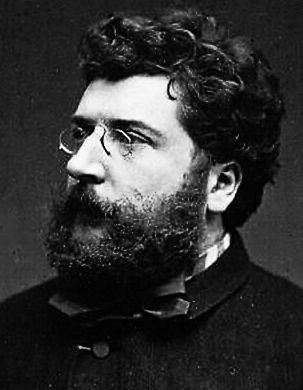
The artistic life of capital cities is fast moving; who or what is in fashion one year is considered démodé the next. So when Georges Bizet won the prestigious Prix de Rome, which meant three years studying at the Villa Medici in Rome, he discovered that it was something of a double edged sword; since, when he returned to Paris after his sojourn in Rome, he found that the city’s music had moved on without him.
Despite his efforts, re-establishing his reputation proved to be immensely difficult. Neither of his operas Les pêcheurs de perles [The Pearl Fishers] and La jolie fille de Perth [The Fair Maid of Perth] were successful; the only bright spot was his well received incidental music for Alphonse Daudet’s play L’Arlésienne [The Girl from Arles] (though the play itself was – initially, anyway – a flop).
Reduced to giving piano lessons, acting as copyist and arranger for other, more successful, composers and as a repetiteur, Bizet pinned his hopes on his final opera, Carmen. But, their ‘sophistication’ notwithstanding, Parisian audiences were not yet ready for a ‘verismo‘ opera about a gypsy seductress who works in a cigarette factory. And, so the story goes, this final failure hastened the death of its composer at the age of thirty-six.
The music for that one bright spot – L’Arlésienne – was arranged into two popular orchestral suites, the first by Bizet himself; the second after the composer’s death by his friend Ernest Guiraud.
0:00 Suite No.1 ·I. Prelude
6:52 ·II. Minuet
9:50 ·III. Adagietto
13:30 ·IV. Carillon
&
17:20 Suite No.2 ·I. Pastorale
23:15 ·II. Intermezzo
28:30 ·III. Minuet
33:00 ·IV. Farandole
Score (Suite 1)
Score (Suite 2)
Any copyrighted material on these pages is included as “fair use”, for the purpose of study, and critical analysis only, and will be removed at the request of the copyright owner(s).
 The Art of Listening