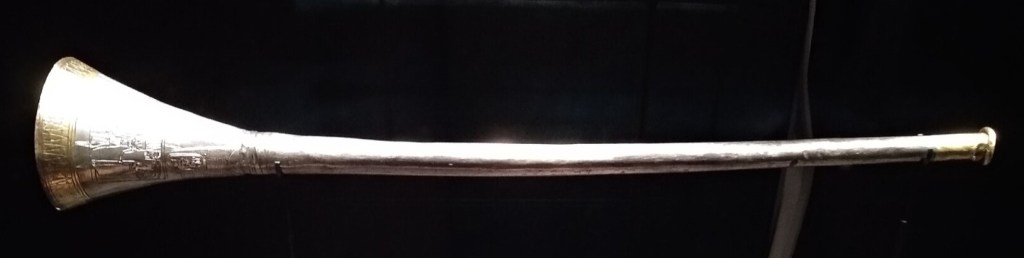
The trumpet’s long history is demonstrated by the image above, an instrument found in the tomb of Tutankhamun.
Moving slightly(??) forward in time, as with the horn, in the Baroque period players specialised in the upper so called ‘clarino’ registers of the natural trumpet, where the pitches are close enough together to play the contrapuntal lines of the period.
Modern performers of Baroque trumpet music have a number of options open to them of which there are two examples below in performance of Bach’s second Brandenburg Concerto:
(nearly) Authentic: playing the natural trumpet with vent holes to correct the out of tune partials:
Bach: Brandenburg concerto No. 2
0:00 Allegro
4:41 Andante
8:08 Allegro assai
Non-authentic: performance on the modern ‘piccolo’ trumpet complete with valves:
Allegro 00:00
Andante 05:02
Allegro assai 08:53 ∙
By the classical period (i.e. the time of Haydn and Mozart) the virtuoso skills of the clarino players had disappeared; the trumpet – lacking, for obvious reasons, the hand adjustments available to the horn – became mostly limited to the notes of the middle range (3-12) harmonics/partials you see below:

(the diamond shaped notes above are approximate i.e. they’re flat, ‘out of tune’.)
There were, however, efforts to extend these limits, the most famous of which (invented by a certain Anton Weidinger) was the keyed trumpet, an instrument that had concertos written for it by both Haydn and Hummel. Unfortunately, the instrument’s poor tone and uncertain tuning weighed against its survival, and the arrival of the more efficient and better sounding modern trumpet with its pistons ensured its eventual demise.
Hummel: Trumpet concerto
The first movement played on the keyed trumpet for which it was written:
… and the entire work played on the modern instrument:
00:00:00 Allegro con spirito
00:10:01 Andante
00:14:18 Rondo
The trombone went through none of these transformations. From its earliest days (in the fourteenth century – but then known as a sackbut) it has been a slide instrument, a slide which allowed for a straightforward and efficient way of increasing and shortening its sounding length.
The Sackbut
It took until the late eighteenth century for the instrument to be accepted into the orchestra (Mozart uses it in Don Giovanni and his Requiem; Beethoven in some of his later symphonies). But by the time of Mendelssohn and Schumann, as this Concertino by their contemporary, the violin virtuoso Ferdinand David demonstrates, it had become an established member of the instrumental ensemble:
Ferdinand David:
Concertino for trombone and orchestra
00:00 – Allegro maestoso
06:10 – Marcia funebre (Andante)
10:32 – Allegro maestoso
As an instrument the trombone seems to have a split personality, moving between great dignity (see David’s funeral march above) and – in this wonderful performance by Christian Lindberg – a clownish mixture of fun and existential crisis:
Luciano Berio:
Sequenza V for solo trombone
Any copyrighted material on these pages is included as “fair use”, for the purpose of study, and critical analysis only, and will be removed at the request of the copyright owner(s).
Pontarddulais!
 The Art of Listening