There are lots and lots of percussion instruments, as this video will demonstrate (but, despite its claim, I don’t think that its instrument list is quite exhaustive)…
So, rather than spread history and description too thinly, this page will concentrate on what are, perhaps, the most familiar and used members of the percussion family, the timpani (aka kettledrums):
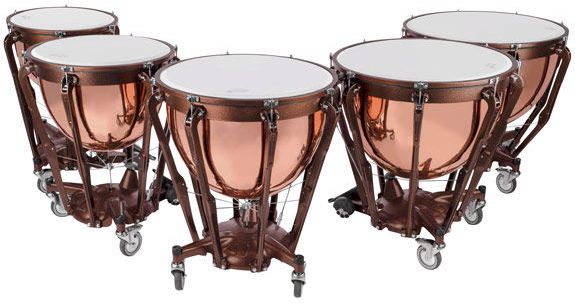
They consist of a membrane – either animal skin or plastic – stretched across a bowl normally made of copper. They are pitched instruments whose pitch can be adjusted either by handles arranged around the rim or by foot pedals. They frequently come in sets of four arranged (as above) from large/low to small(er)/high. The range of each drum is somewhere around seven semitones/a perfect fifth.
Drums have been used from time immemorial – whether you’re in charge of the rowing of a trireme or coordinating the marching of an army (when they were frequently used together with trumpets), a drum is an extremely useful piece of equipment!
The first known examples of the timpani/drum’s orchestral use are by Monteverdi in his Orfeo:
and Bach in a secular cantata for the birthday of local royalty entitled Tönet, ihr Pauken! Erschallet, Trompeten! [Sound the drums, ring out the trumpets] which, you may have noticed, he later recycled for the opening of his Christmas Oratorio:
Haydn, in his last but one symphony (No. 103, E-flat) surprised (and maybe woke up) his London audience by starting the work with a solo for drum, earning the piece its nickname of ‘the Drum Roll’
Beethoven also used the timpani in, at the time, unusual ways:
announcing one of the movement’s main motifs at the start of the first movement of his violin concerto…
…and to hammer out the Scherzo’s main rhythm in his Ninth Symphony:
Berlioz uses several timpani and – in this performance – two players to send his hero to his death on the scaffold in his Symphonie fantastique:
By the time we get to the twentieth century things have changed. One of the problems of the instrument for Baroque, Classical and Romantic composers was tuning. Most orchestras had only two kettle drums and they were frequently tuned to the home note (tonic) and its nearest relative (dominant) of the principal key of any given work – it was difficult to re-tune them in the course of a single movement; so when the music changed key the drums were often, perforce, silent. One solution to the problem was simply to increase the number of timpani (see Berlioz above) but, with the invention in the twentieth century of pedals that could change the membrane’s tension almost instantly, the problem was solved.
Carl Nielsen translates the trials and tribulation of humanity (and the triumph of man’s ‘inextinguishable’ nature) into music by writing, at near the end of his Fourth Symphony, a dual for two timpanists:
While Béla Bartók’s Adagio from his Music for Strings, Percussion & Celesta, weaves a tapestry of night sounds with eerie drum glissandos as background:
Lastly a Fantasy Concerto by Philip Glass for two timpanists and no less than twelve timpani:
Movement I – 1:01“
Movement II – 6:58“
Cadenza – 14:30“
Movement III – 18:15“
Any copyrighted material on these pages is included as “fair use”, for the purpose of study, and critical analysis only, and will be removed at the request of the copyright owner(s).
 The Art of Listening