The sound of one of Chopin’s own pianos, a Pleyel:
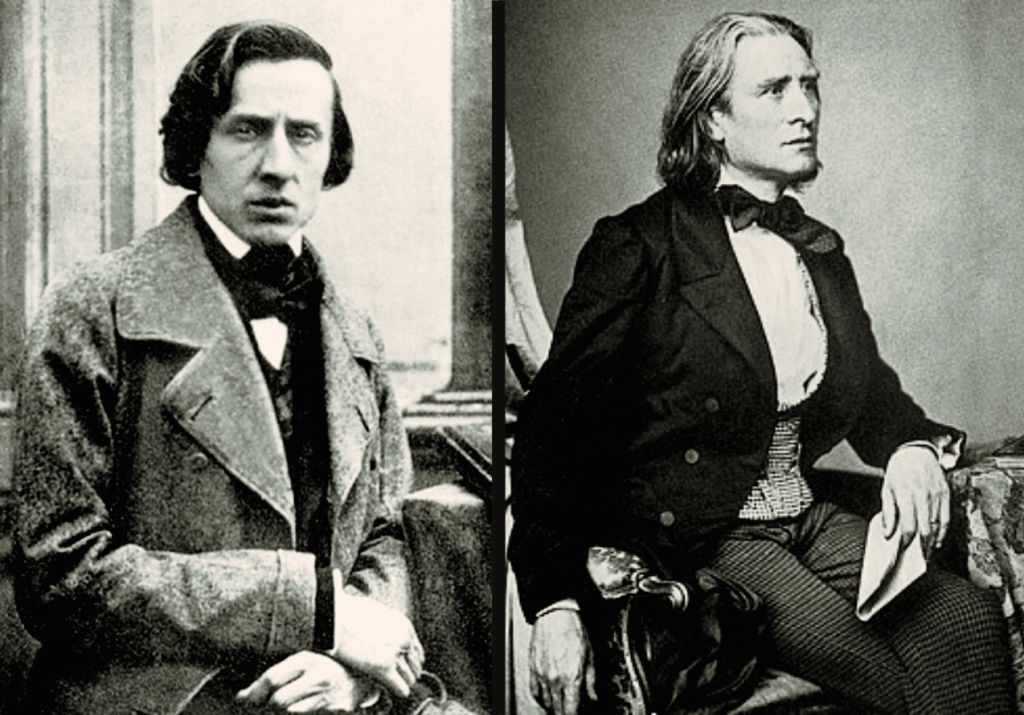
Chopin and Liszt were friends and lived in close proximity in Paris for some years; they also performed together on a number of occasions.
It must have been an interesting friendship since, in terms of personality, they were almost polar opposites. While both were acknowledged as great keyboard virtuosos, Chopin was shy, retiring and disliked public performance – he gave only just over thirty concerts in the course of his (admittedly short) life. Liszt was a born showman and, seemingly, revelled in public appearance.
And their music seems to reflect this. True, there are barnstorming moments in Chopin, the famous ‘Revolutionary Étude’ in c, for instance (below), but mostly it’s the delicate fiorature (decorations) of his long melodic lines that seem to characterise his music.
It can seem difficult to stop Liszt thundering up and down the (now extended) length of the piano, and he induced an almost pop-star like adulation in (particularly the female) members of his audience.
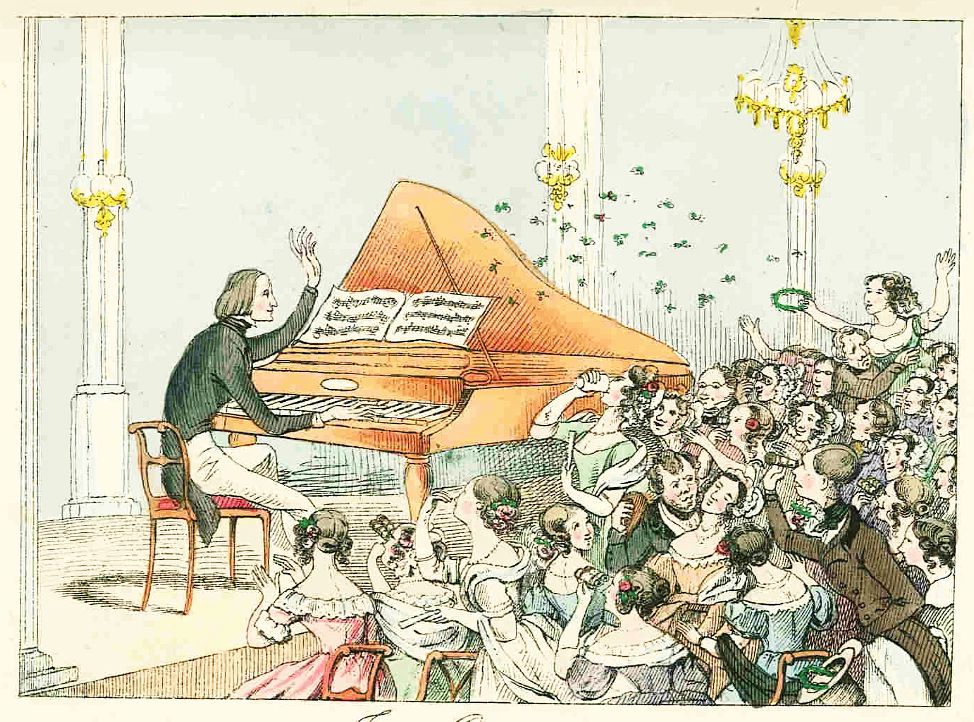
This Barnum & Bailey aspect of his persona is counterbalanced by moments of great musical delicacy, and his being one of the major harmonic innovators of the nineteenth century.
Chopin wrote two books of twelve études/studies each for the piano (respectively opus 10 and 25). They’re dedicated to the composer’s friend, Franz Liszt:
Op. 10, No. 4 in c# named – not, I believe by Chopin – Torrent:
Op. 10, No. 12 in f, again not the composer’s title, but well-known as the Revolutionary:
Listen to the twelve Op. 10 Studies played by Jan Lisiecki
The sound of one of Liszt’s many pianos, not in this case the favoured make, Érard but seemingly a Bechstein:
Liszt also wrote a series of studies which he, with typical bravura, described as ‘transcendental’ :
No. 10 in f, Allegro agitato molto
No. 5 in B-flat, Allegretto, entitled Feux-Follets [Will o’the Whip]
Listen to all twelve Transcendental Studies played by Daniil Trifonov.
Any copyrighted material on these pages is included as “fair use”, for the purpose of study, and critical analysis only, and will be removed at the request of the copyright owner(s).
 The Art of Listening