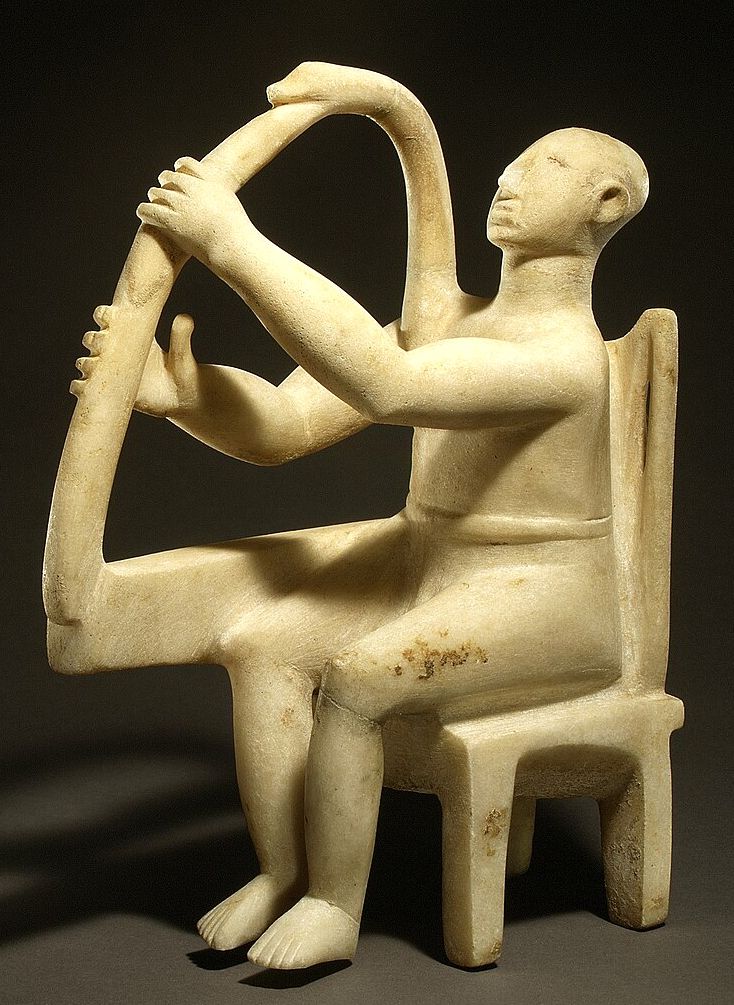
The harp has a long, long history – the harpist above was discovered on the Aegean islands of the Cyclades and dates from between 2800 and 2700 BC.
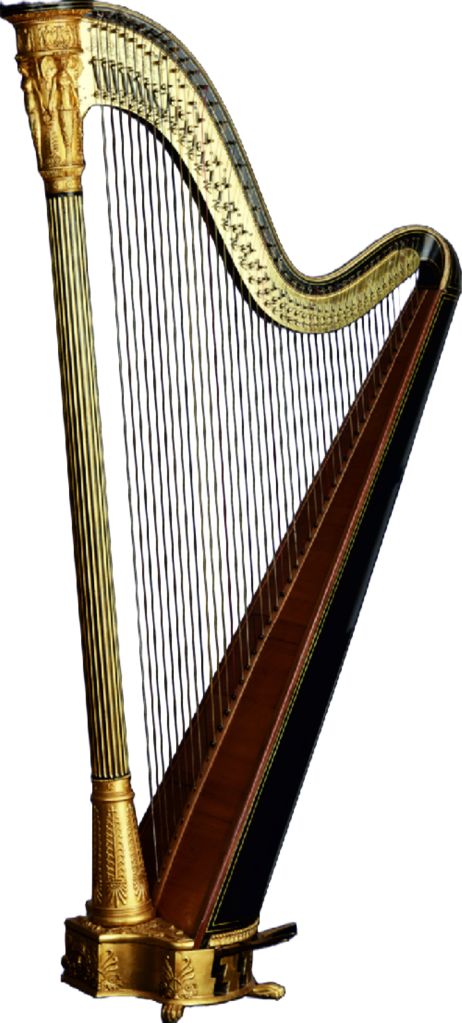
As you can see, apart from a general triangular shape, the modern version of the instrument has become considerably more complex and ornate and stands around six foot tall, weighing about eighty pounds.
It’s slightly more recent(!) history includes Baroque works e.g. this concerto by Handel:
Andante Allegro – :29
Larghetto – 5:00
Cadenza (Grandjany) – 8:50
Allegro Moderato – 12:24
… and a Classical double concerto, with flute, by Mozart:
Allegro 0:28
Andantino 10:23
Rondeau: Allegro 19:19
As with many orchestral instruments, the harp’s construction has changed considerably over time. It was one of these developments (or its failure!) that resulted in the two works below by Debussy and Ravel both of which have become standard repertoire for the instrument.
In 1904 Debussy was commissioned by the head of Pleyel, the harp making firm, to write a piece to promote their newly invented chromatic harp; the result was the Danse sacrée et danse profane [Sacred and profane dances] for harp and strings:
Danse sacrée 0:00
Danse profane 4:49
Pleyel’s main harp making rivals, Érard – who still made the traditional, diatonic harp with pedals – countered this in 1905 by commissioning a piece to showcase their instruments from another famous French composer, Maurice Ravel. He produced a septet for flute, clarinet, harp and string quartet, which he called simply Introduction et allegro:
Like so many innovative ideas, the Pleyel harp was never really a success (witnessed by the fact that harpists are still playing the Érard style pedal instruments). It’s worth noting, though, that Debussy – maybe anticipating the possible failure of Pleyel’s new instrument – pretty much ensured that his piece was playable on both chromatic and diatonic harps.
The harp can produce a multitude of special effects, this multi-timbral world is well illustrated in the music written by famous harpist, Carlos Salzedo (he gave the first performance of Debussy’s Danse sacrée et danse profane in America). Here are two examples (the second of which, being a piece that makes use of pedal glissandos, also gives us an opportunity to observe pedal technique):
Any copyrighted material on these pages is included as “fair use”, for the purpose of study, and critical analysis only, and will be removed at the request of the copyright owner(s).
 The Art of Listening