
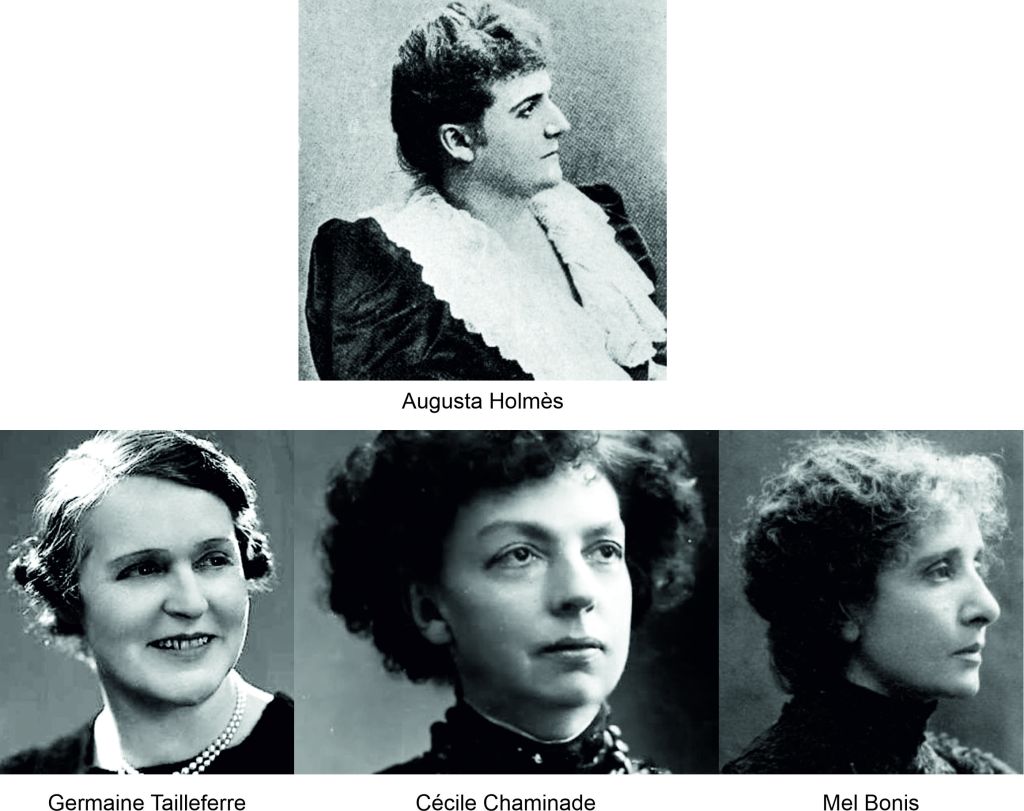
Four composers: in France women were not given the vote until 1944.
The private home concert or “Salon” was the primary, socially acceptable venue for women to perform and present their own works. This led to specialization in specific genres (mélodies, piano miniatures, chamber music). Women, when they received a musical education, were also directed toward these “feminine” forms and discouraged from “masculine” symphonies, operas, and large religious works. Even popular female composers were often judged firstly by their gender and physical appearance, and only then by their music. The perception was that a woman could not achieve “genius” due to social and biological constraints.
Augusta Holmès (1847–1903) was of Irish decent. She studied with César Franck and was a friend of Saint-Saëns (he proposed marriage, but was turned down). Given her dates, the principle musical influence on her was inevitably Wagner via her teacher, César Franck:
Augusta Holmès: Irelande
Cécile Chaminade (1857–1944): her style is highly accessible, lyrical, graceful, and rhythmically charming—perfectly tailored for the Belle Époque audience. She was the first woman composer to be awarded the Légion d’honneur (1913).
Cécile Chaminade: Concertino for Flute, Op. 107
Mélanie Bonis (1858–1937): Bonis, like Holmès, studied with César Franck. Due to an arranged marriage and social convention, she adopted the pseudonym Mel Bonis and often had to compose in secret, managing a double life between her bourgeois duties and her artistic drive.
Mélanie Bonis: Scènes de la forêt
00:00 Nocturne
03:40 À l’aube
07:30 Invocation
10:09 Pour Artémis
Germaine Tailleferre (1892–1983): the only female member of Les Six, a group which included Milhaud, Poulenc and Honegger; they rejected Romanticism and Impressionism in favor of clarity, wit, and simplicity i.e. Neoclassicism.
Germaine Tailleferre:
Concertino for Harp and Orchestra
Any copyrighted material on these pages is included as “fair use”, for the purpose of study, and critical analysis only, and will be removed at the request of the copyright owner(s).
Pontarddulais!
 The Art of Listening