After the emotional cataclysm of Adieu, colombe verte, the next song (Syllabes [Syllables]) moves the lovers into a distant, whispered, spiritual world that is violently contrasted with the jungle of Peruvian folk-tale and its monkey cries of pia, pia.
Turangalîla 2 at about 4 minutes, is the shortest of the symphony’s movements. It’s dominated by piano and percussion and ends, ominously, with the statue motif.
The penultimate Rechant‘s vocal writing is challenging (to say the least!) for the two bass soloists who have to sing in parallel augmented fourths/diminished fifths, one of the most difficult of harmonic intervals – the diabolus in musica, .
Olivier Messiaen:
Harawi
VIII. Syllabes
Turangalîla-symphonie:
Turangalîla 2
I. Introduction 0:00:48
II. Chant d’amour 1 0:07:31 ∙
III. Turangalîla 1 0:15:58 ∙
IV. Chant d’amour 2 0:21:30
V. Joie du sang des étoiles 0:32:56
VI. Jardin du sommeil d’amour 0:39:53 ∙
VII. Turangalîla 2 0:52:02
VIII. Développement de l’amour 0:55:45
IX. Turangalîla 3 1:07:25
X. Final 1:12:38 ∙
Cinq rechants:
Rechant 4
Paul Dukas:
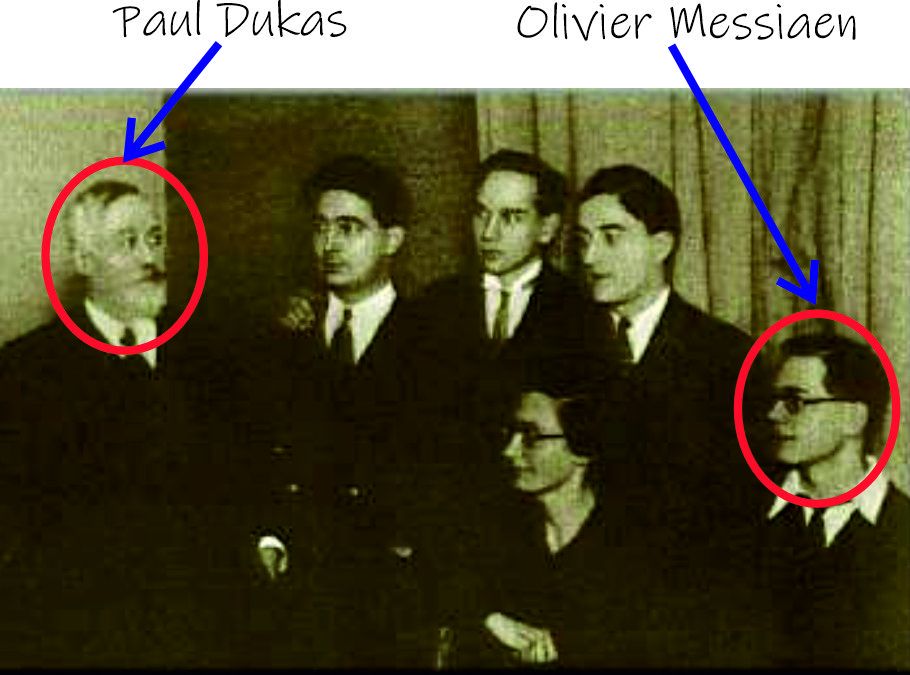
The image is a detail from a photo of Dukas (1865-1935) surrounded by his Conservatoire composition pupils; and, as you can see, in the far righthand corner lurks one of the most famous of them.
Dukas has, thanks mainly to the influence of Walt Disney and Disney’s alter ego, Mickey Mouse, become world famous for just one work – The Sorcerer’s Apprentice:
…and it is, undoubtedly both a brilliant score and piece of animation. But there’s more to Dukas than The Sorcerer’s Apprentice.
Though tough self-criticism meant that not many works reached his stringent standards and were passed on to the world, those that we do have are, like The Sorcerer’s Apprentice, of an extremely high quality. Two examples: his only symphony and the so-called ‘French Hammerklavier’, his piano sonata in e-flat minor.
Symphony in C
Allegro non troppo vivace, ma con fuoco (0:00)
Andante espressivo e sostenuto (13:42)
Allegro spiritoso (28:16)
Sonata in e-flat
00:00 Modérément vif (expressif et marqué)
09:56 Calme – un peu lent – très soutenu
21:18 Vivement – avec légèreté
29:54 Très lent
Any copyrighted material on these pages is included as “fair use”, for the purpose of study, and critical analysis only, and will be removed at the request of the copyright owner(s).
 The Art of Listening