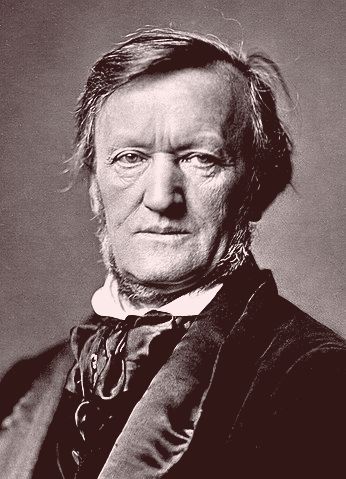
Richard Wagner
(1813-1883)
On the 13th of August, 1876 in the small German town of Bayreuth, at the newly built Festspielhaus, the first complete cycle of Richard Wagner’s four-part music drama Der Ring des Nibelungen [The Ring of the Nibelung] opened with a performance of Das Rheingold [The Rhinegold].
Rhinegold was, in the composer’s view, a new type of work, bringing together all the arts (a Gesamtkunstwerk) and, in the process, ditching the traditional divisions of opera – aria, chorus, ensemble – in favour of continuous music and a system of constantly developing musical ideas associated with characters, objects or moods – the leitmotif. Hence the title of ‘music drama’ rather than opera.
Described as a Vorabend [literally a ‘pre-evening] Rheingold forms a one act, 2½ hour introduction to the three larger music dramas that follow (The Valkyrie, Siegfried and Götterdämmerung [Twilight of the Gods]) that followed.
The challenge of staging The Ring with its gods, dwarves, giants, dragons, etc., has produced many interesting (and sometimes distinctly odd) productions. Here are a few examples, taken from Das Rheingold.
The Prelude (136 bars of the chord of E-flat):
The Rhinemaidens and their gold:
The giants, Fafner and Fasolt:
Wotan and Loge descend to Nibelheim:
Loge tricks Alberich into turning himself into a snake and a toad:
Alberich curses the ring:
The Earth Goddess, Erde warns Wotan not to keep the Ring:
The gods cross over the Rainbow Bridge into Valhalla:
You can watch the whole music drama with English subtitles by clicking on:
Das Rheingold
Any copyrighted material on these pages is included as “fair use”, for the purpose of study, and critical analysis only, and will be removed at the request of the copyright owner(s).
 The Art of Listening