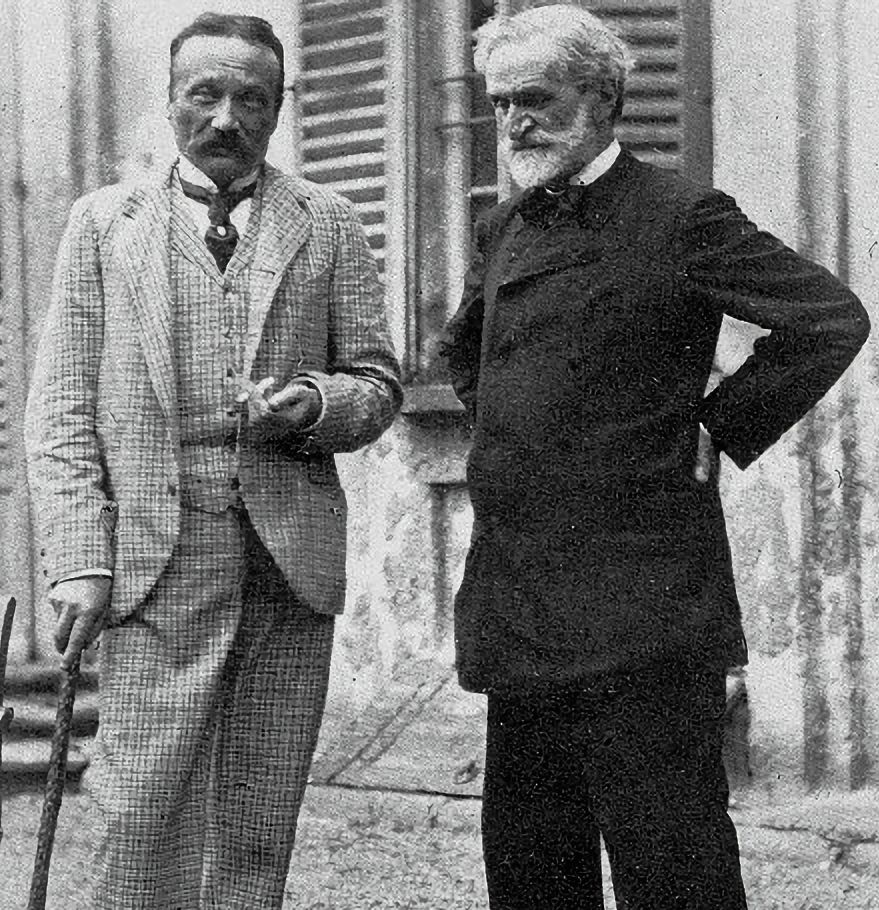
Guiseppe Verdi (1813-1901)
Verdi was born into the bel canto world of the operas of Rossini, Bellini and Donizetti but soon began to demonstrate a strongly personal voice. Like Wagner, he’d attempted a comic opera early in his career (Un giorno di regno [A day’s reign/King for a day]) and, again like Wagner, it had been a resounding flop.
It wasn’t until the composer was nearly eighty that he returned to the genre. Casting about for a subject, Verdi eventually received a libretto from Arrigo Boito (see photo above) with whom he’d collaborated on their version of Shakespeare’s Othello (Otello). Boito – himself a fine composer – had knocked together three more Shakespearian plays, The Merry Wives of Windsor and Henry IV parts 1 & 2, to make an opera centred around the character of Sir John Falstaff, which he had – very sensibly – entitled Falstaff.
Verdi was delighted with the idea and, shelving worries about embarking on such a project at his advanced age, by 1893 the now eighty year old composer’s new opera, Falstaff, was given its first performance at La Scala, Milan.
Some excerpts:
Falstaff harangues Bardolf and Pistol when the two highly dubious characters, refuse to deliver Falstaff’s letters claiming it is dishonourable:
Meg and Alice receive the dishonourable letters:
Mistress Quickly delivers Alice’s reply (1):
Mistress Quickly delivers Alice’s reply (2):
Ford discovers his wife’s supposed infidelity…
… and gives way to anger:
An attempt at seduction:
Sir John, having been dumped in the Thames, takes a very gloomy view of the world, but then along comes a glass of mulled wine…
Poor Falstaff is fooled for the second time by a gang of fake fairies led by Alice’s daughter, Nannetta as fairy queen:
The finale (and the moral): ‘We’re all sometimes mocked, but he who laughs last, laughs longest!’
You can watch the whole opera by clicking on:
Falstaff
Any copyrighted material on these pages is included as “fair use”, for the purpose of study, and critical analysis only, and will be removed at the request of the copyright owner(s).
 The Art of Listening