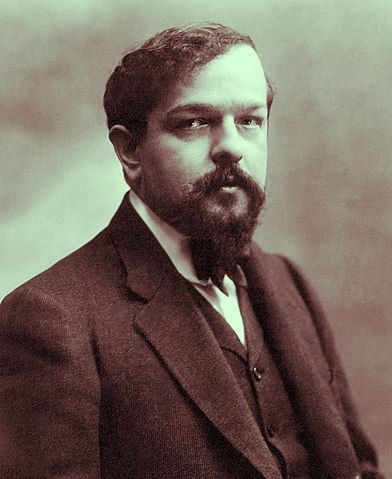
Claude Debussy (1862-1918)
Debussy’s only opera Pelléas & Mélisande is, in part, a reaction to the aesthetic hegemony of the music dramas of Richard Wagner.
The French composer had moved from profound admiration for Wagner to the view that the German composer’s music marked the end, rather than the beginning of a tradition (in Debussy’s words, a sunset rather than a dawn).
That said, despite being a reaction against music drama, Debussy’s opera contains much that can be viewed as inherited from Das Rheingold, etc. (leitmotifs, declamation, continuous music…)
An interview with the creator of the role of Mélisande, Mary Garden:
Some excerpts:
Golaud and Mélisande meet in the forest (1):
Golaud and Mélisande meet in the forest (2) – concert version:
Geneviève, wife of Arkel king of Allemond, reads the letter that Golaud has written to his half-brother, Pelléas:
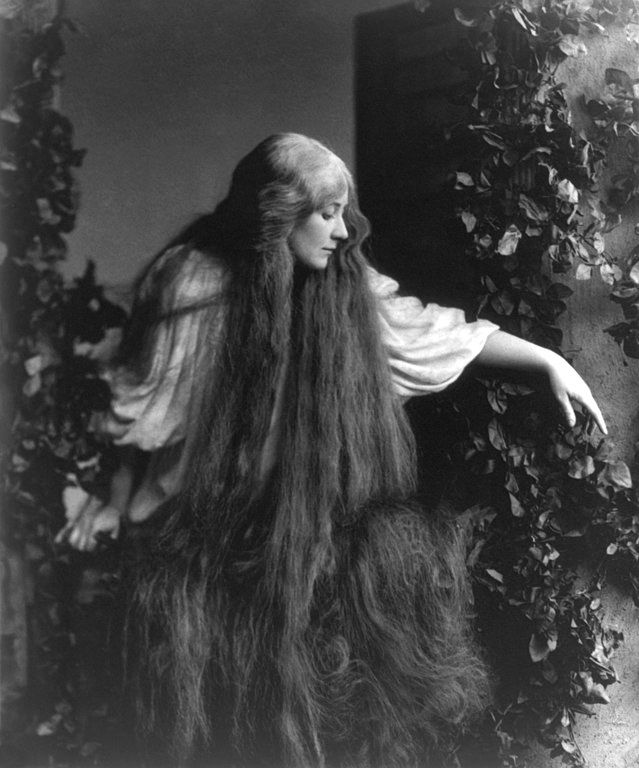
Rapunzel-like, Mélisande lets her long hair down (Mary Garden accompanied by Debussy – if you listened to the opening of the interview with Ms. Garden above, you’ll have heard this before)(1):
Rapunzel like, Mélisande lets her long hair down in a recent Paris Opera production (2):
An interesting – it’s set in a psychiatric ward(??) – directorial interpretation of the end of the above scene:
A jealous Golaud lures Pelléas to the abyss that lies beneath the castle:
Part of the love scene:
You can watch the WNO production of the
opera (Pierre Boulez, Peter Stein) by clicking on:
Pelléas & Mélisande (Part 1)
Pelléas & Mélisande (Part 2)
Poor video quality, but a great performance!
Any copyrighted material on these pages is included as “fair use”, for the purpose of study, and critical analysis only, and will be removed at the request of the copyright owner(s).
 The Art of Listening