
Stravinsky wrote the Symphony of Psalms in 1930 as a result of a commission from the conductor of the Boston Symphony Orchestra, Serge Koussevitzky for a work to celebrate the orchestra’s fiftieth anniversary .
The piece is in three sections and draws its text from Psalms 38, 39 and 150. It’s scored for chorus and an orchestra which includes two pianos but from which Stravinsky omits clarinets, violins and violas.
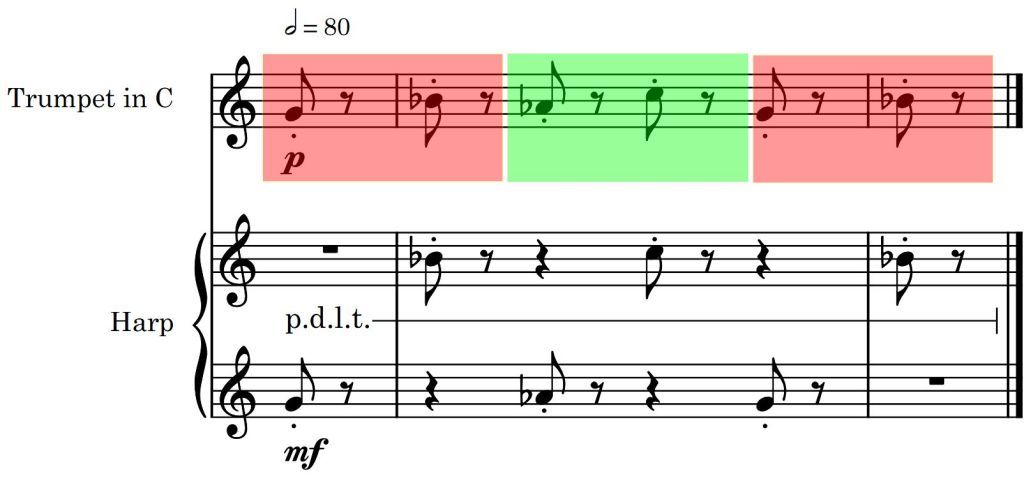
According to the composer, the work is derived from a cell of minor third (red), major third (green), minor third (red) which appears in trumpet and harp near the start of the fast section of Psalm 150 (the movement he wrote first).
00:00 – 1st movement (Psalm 38: v. 13-14)
03:24 – 2nd movement (Psalm 39: v. 2,3 & 4)
10:07 – 3rd movement (Psalm 150)
Romeo & Juliet – like the Second Violin Concerto – dates from 1935 but the ballet had to wait until 1938 for a full, staged performance. Like the violin work, the ballet is in the composer’s more lyrical vein.
Here’s a complete performance given by the Paris Opera with choreography and staging by Rudolf Nureyev:
Scene 1
0:33 Intro
04:24 Romeo
Scene II
28:24 Dance of the knights
34:00 Sword dance
35:17 Juliet’s variations
37:59 Mercutio
40:49 Madrigal
50:18 Balcony scene
53:25 Dance of love
Act II
Scene 1
1:00:43 Interlude
1:04:06 Dance of the people
1:08:13 Dance of the five couples
1:11:26 Dance with mandolins
1:13:25 The housekeeper
Scene 2
1:16:25 Romeo and Juliet with Friar Laurence
Scene 3
1:19:33 People still celebrating
1:21:37 The fight between Tybalt and Mercutio
1:27:33 Romeo avenges Meecuzio’s death
Act III
Scene I
1:31:20 Introduction
1:33:43 Juliet’s bedroom
1:38:59 The housekeeper
1:41:31 Juliet refuses to marry Paris
1:42:30 Juliet alone
Scene 2
1:45:34 From Brother Laurence
Scene 3
1:48:43 Juliet’s bedroom
1:49:29 Morning serenade
1:53:07 Juliet dies
1:57:34 Dance of the girls
2:03:09 At Juliet’s bedside
Epilogue
2:03:57 Juliet’s funeral
Any copyrighted material on these pages is included as “fair use”, for the purpose of study, and critical analysis only, and will be removed at the request of the copyright owner(s).
Iaago
 The Art of Listening