It’s butt of lots of (other) orchestral players’ jokes, but the voila is an very essential part of the string section, fulfilling as it does the tenor role in the ensemble. Its position ‘inside’ of the harmony may be the reason that many composers (Bach, Mozart, Beethoven, Mendelssohn, Dvořák, etc.) have played the instrument.
The voila’s size isn’t commensurate with the pitch of its lower strings – it would have to be over 1½ times bigger than the violin to stay in proportion to its smaller relative, a size that would make it impossible to handle – so the instrument is a compromise between acoustic demands and human physique; a compromise which contributes to the instrument’s unique sound.
In this double concerto (aka Sinfonia Concertante) Mozart employs scordatura (i.e. tuning strings differently to standard pitches). In pursuit of brightening the instrument’s sound, he asks the solo violist to tune all their strings up a semitone. Most modern players, however, play the work without employing the changed tuning.
1. Allegro maestoso 1:08
2. Andante 15:20
a3. Presto – 26:50
Berlioz’ Harold en Italie (based [very!!] loosely on Byron’s Childe Harold) was written as a result of a request by Paganini for a showpiece for his newly acquired Stradivarius viola. In it, the viola, as Childe Harold himself, is pictured wandering in the Abruzzi and is the participant in/observer of, scenes conjured by the orchestra. Unfortunately, when Paganini was shown the score he found the solo writing both not brilliant enough and too sporadic for his needs and never played the piece.
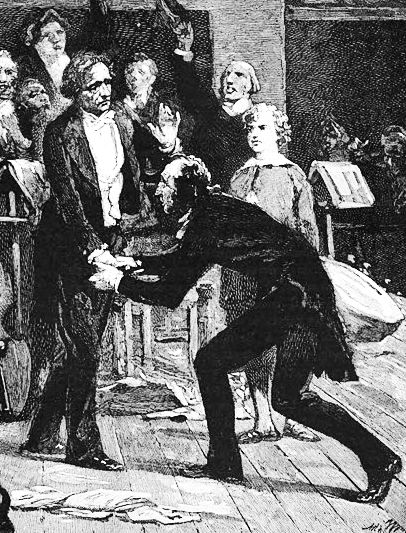
Years later, when he attended a performance of the work, Paganini was deeply moved and fell on his knees in worship before the composer; a little later he sent Berlioz a considerable sum as a commissioning fee.
1. Harold aux montagnes (Adagio-Allegro) 0:38
2. Marche des pèlerins (Allegretto) 15:10
3. Sérénade d’un montagnard (Allegro assai-Allegretto) 22:20
4. Orgie de brigands (Allegro frenetico-Adagio) 28:55
And here’s another work that was initially rejected by the performer it was intended for.
When, in 1929, William Walton sent the score of his viola concerto to the British violist Lionel Tertis, Tertis turned down the piece as being too modern for him. Like Paganini above, the performer eventually recanted, but Tertis – unlike the Italian virtuoso with Harold en Italie – got to perform the Walton several times.
I. Andante comodo 00:36
II. Vivo, con molto preciso 09:26
III. Allegro moderato 14:16 ∙
Due to the problems with the proposed soloist in the above work, it became necessary to find a another player to give the first performance. So it was Paul Hindemith, violist and distinguished composer, who gave the Walton Viola Concerto its premier.
Hindemith was, later (1935), to write his own viola concerto which was based around German folk-tunes and named Der Schwanendreher* [The swan turner] after the melody used as the theme of the finale’s variations.
I. »Zwischen Berg und tiefem Tal« [Between mountain and deep valley]. Langsam – Mäßig bewegt, mit Kraft 00:33
II. »Nun laube, Lindlein, laube!« [Now grow leaves, little linden tree, grow leaves]. Sehr ruhig – »Der Gutzgauch auf dem Zaune saß« [The Cuckoo Sat on the Fence]. Fugato — Wie am Anfang 08:55
III. Variationen »Seid ihr nicht der Schwanendreher« [Variations: “Aren’t you the swan turner?]. Mäßig schnell – Ruhig bewegt – Zeitmaß wie früher – Lebhafter 18:02 ∙
* A ‘swan turner’ was a hurdy-gurdy man, so named because the turning handle of the instrument was sometimes in the shape of a swan’s head and neck.
This last concerto dates from 1944.
As a result of the Second World War, in 1940 Bartók had (reluctantly) moved to America. And it was the American violist, William Primrose, who commissioned this viola concerto. The composer died with the work unfinished, and Tibor Serly, Bartók’s friend, produced the first performing edition of the work (there have been several others since).
I. Moderato 00:00
II. Adagio religioso 13:58
III. Allegro vivace 16:45 ∙
Any copyrighted material on these pages is included as “fair use”, for the purpose of study, and critical analysis only, and will be removed at the request of the copyright owner(s).
 The Art of Listening