
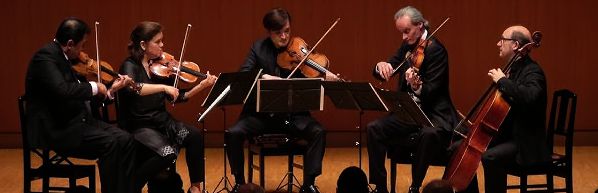
When you’re familiar with ‘classical’ music, if someone mentions a performance by four players, chances are that you’ll assume that they’re talking about a string quartet. The ensemble is, after all, one of the standard groupings of the art, possessing the richest repertoire of any chamber group.
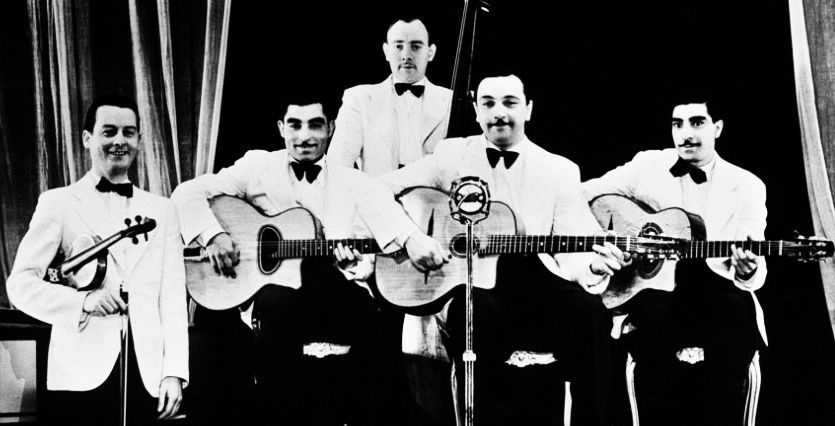
But, mention of five players puts the music buff in a quandary, since, unlike the string quartet, there is a whole gaggle of five player ensembles: there’s string quartets augmented by an extra string player (generally either a viola or cello); then there’s the different variants of the piano quintet; and what about the wind quintet, the brass quintet and the various jazz groups like the Quintette du Hot Club de France pictured above? And that’s not to mention the great operatic quintets by, for instance, Mozart, Bizet or Wagner…
Let’s start, though, on familiar ground, the string quartet plus one other string player – in this case a viola – and one of this particular quintet formation’s most famous instances – Mozart’s Quintet in g, K.516:
Allegro
Menuetto and Trio. Allegretto. 11:15
Adagio ma non troppo 16:23
Adagio — Allegro. 24:03
Another quintet by Mozart but, just to emphasise the diversity of these groups of five, this one’s for wind and piano.
00:00 Largo – Allegro moderato
10:19 Larghetto
19:08 Allegretto
Any copyrighted material on these pages is included as “fair use”, for the purpose of study, and critical analysis only, and will be removed at the request of the copyright owner(s).
Iaago
 The Art of Listening